

Why Does Agency Due Diligence Differ From Shortlisting?
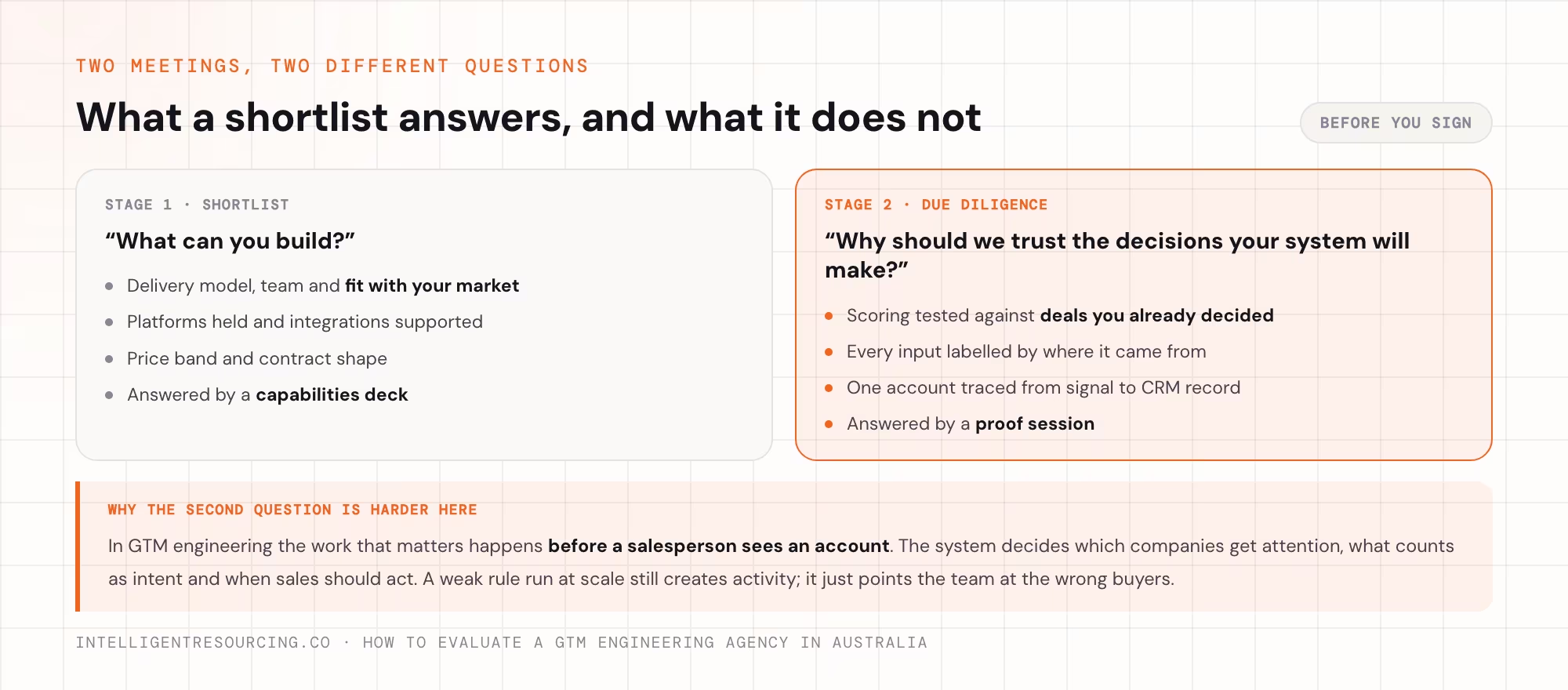
A shortlist shows which GTM engineering agencies look capable. Due diligence shows whether their decision system has earned the right to shape your pipeline. A market comparison such as Intelligent Resourcing's review of GTM agencies for startups can narrow the field by delivery model and fit.
Once 2 or 3 agencies remain, the test shifts from "what can you build?" to "show me why we should trust the decisions your system will make."
That test is harder for GTM engineering than for a campaign agency, because the work that matters happens before a salesperson sees an account. The system shapes which companies get attention, what counts as intent and when sales should act. A weak rule run at scale still creates activity. It just moves the team away from the right buyers.
The decision to trust that system stays with you. Australia's Voluntary AI Safety Standard said leaders cannot outsource responsibility for the artificial intelligence (AI) they use. On 21 October 2025 the government published the Guidance for AI Adoption, which turns the 10 guardrails and the 8 AI Ethics Principles into 6 essential practices. The first practice is to decide who is accountable, and it extends that to contractors and third-party providers.
Which Decision Tests Should an Agency Pass Before You Sign?
Anyone can show tool skills. Proof of sound decisions is harder. GTM engineering joins these steps into one system, so you test the joins, not the presence of tools. Ask the agency to run its scoring, data and workflows against cases whose outcome you already know.
| Evaluation test | Evidence to request | Weak answer |
|---|---|---|
| Historical validation | Scoring logic applied to already-decided client deals | "It works well for other clients" |
| Evidence provenance | Clear labels for verified, client-supplied and inferred information | Every field presented as equally factual |
| Decision traceability | An explanation of why an account received a score or route | An unexplained AI score |
| Workflow control | A signal, enrichment, score, route, action and CRM map | A slide containing tool logos |
| Data governance | Source, timestamp, update and correction rules | "The database handles that" |
| Commercial measurement | Outcomes connected back to the signal or scoring decision | Meetings reported without causal context |
Tool lists open the talk. The question that matters is "Show me how you know this decision is right."
The privacy regulator takes the same view of AI products. The Office of the Australian Information Commissioner (OAIC) has guidance on buying AI products. It tells businesses to check a product before they adopt it, including whether it has been tested for the use they plan. It also warns that the check is not set and forget.
Test 1: Can the Agency Validate Its Scoring Against Deals You Already Know?
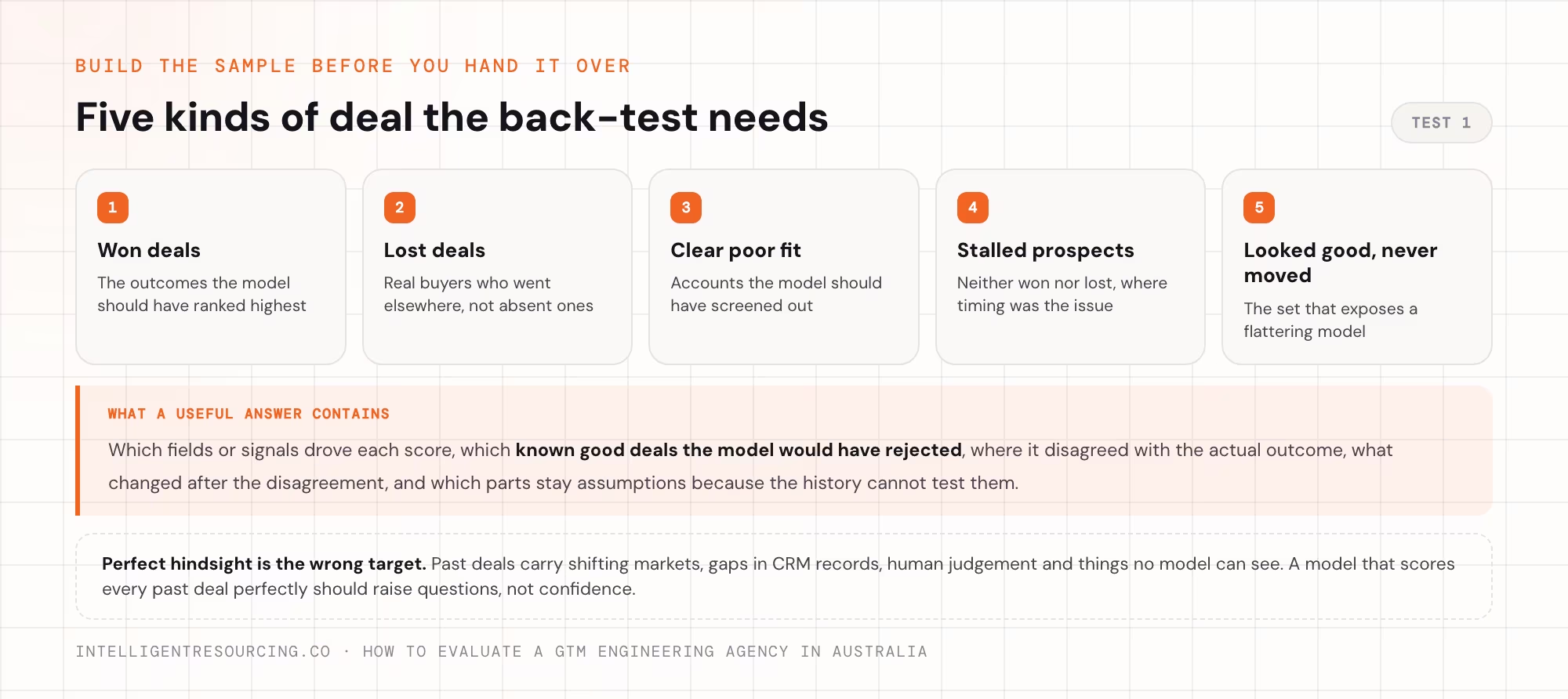
Yes, and it should do so before it scores a single new prospect. Give the agency a sample of deals you have already won, lost or stalled, and ask it to show how its scoring would have ranked them. A useful agency also shows where the model got it wrong and what it changed.
Build the sample with care. Include won deals, lost deals, clear poor-fit accounts and stalled prospects. Add companies that looked good but never progressed.
The agency should then show how its criteria would have treated those accounts. Call this the historical validation test: the scoring is checked against deals you have already decided, and only then trusted on new prospects.
Perfect hindsight is the wrong target. Past deals carry shifting markets, gaps in CRM records and human judgement. They also hold things no model can see. The test is whether the method survives contact with real sales.
Signals can look predictive and still fail. ProductLed's product-led growth benchmarks, drawn from a survey of more than 600 software businesses, report free trials converting at about 25% where product-qualified leads are used, against a free-to-paid median near 9%. ProductLed reads that as roughly 3 times higher. It is an association with no proven cause, so test every signal against your own outcomes.
Ask questions such as:
- Which fields or signals influenced each score?
- Which known good deals would your model have rejected?
- Which poor-fit opportunities would it have prioritised?
- Where did the model disagree with the actual outcome?
- What did you change after seeing those disagreements?
- Which parts of the model remain assumptions because the historical data cannot validate them?
A useful agency shows its mistakes. A model that scores every past deal perfectly should raise questions. If the provider adjusts the model after seeing the data, that is the point of validation. Ask it to explain what changed and why.
Our guide to automated lead scoring in practice covers what the build involves once the logic survives this test. A model that cannot be challenged on known outcomes should not be given unquestioned authority over unknown ones.
Test 2: Can the Agency Separate Verified Evidence From What You Told It?
A good agency labels every input by where it came from, so a checked event never looks as certain as a guess. A GTM scoring model can mix CRM history, job adverts, funding news, tech data and sales-team opinion. Those inputs do not carry equal weight.
Suppose a target company appointed a new chief revenue officer (CRO) in September. Anyone can verify that event. The claim "companies appointing a CRO are 3 times more likely to buy from us" is different. Without proof, it stays a hypothesis.
The provenance test is simple: ask the agency to separate what it can verify externally from what the client told it. A practical model looks like this:
| Evidence state | What it means |
|---|---|
| Externally verified | An independent source supports the underlying fact |
| Client supplied | The information came from the client's CRM, team or internal records |
| Agency inferred | The agency derived a conclusion from available information |
| Validated | The claim has been checked against observed client outcomes |
| Unresolved | The idea may be useful but remains an unproven hypothesis |
Client data is not automatically wrong. An outside source is not right forever. Provenance is the issue. A scoring system should know a fact from an opinion and an inference.
That discipline also matters under Australian privacy law. The OAIC's Australian Privacy Principle (APP) 10 guidance says covered businesses must take reasonable steps to keep personal data accurate, current and complete. It lists due diligence on a third party's quality practices as one such step.
Can the agency show where each key data point came from, when it was seen and whether it is fact, opinion or inference? If not, the score may look precise while resting on assumptions nobody can see.
Can You Trace One Prospect From Signal to Sales Action?
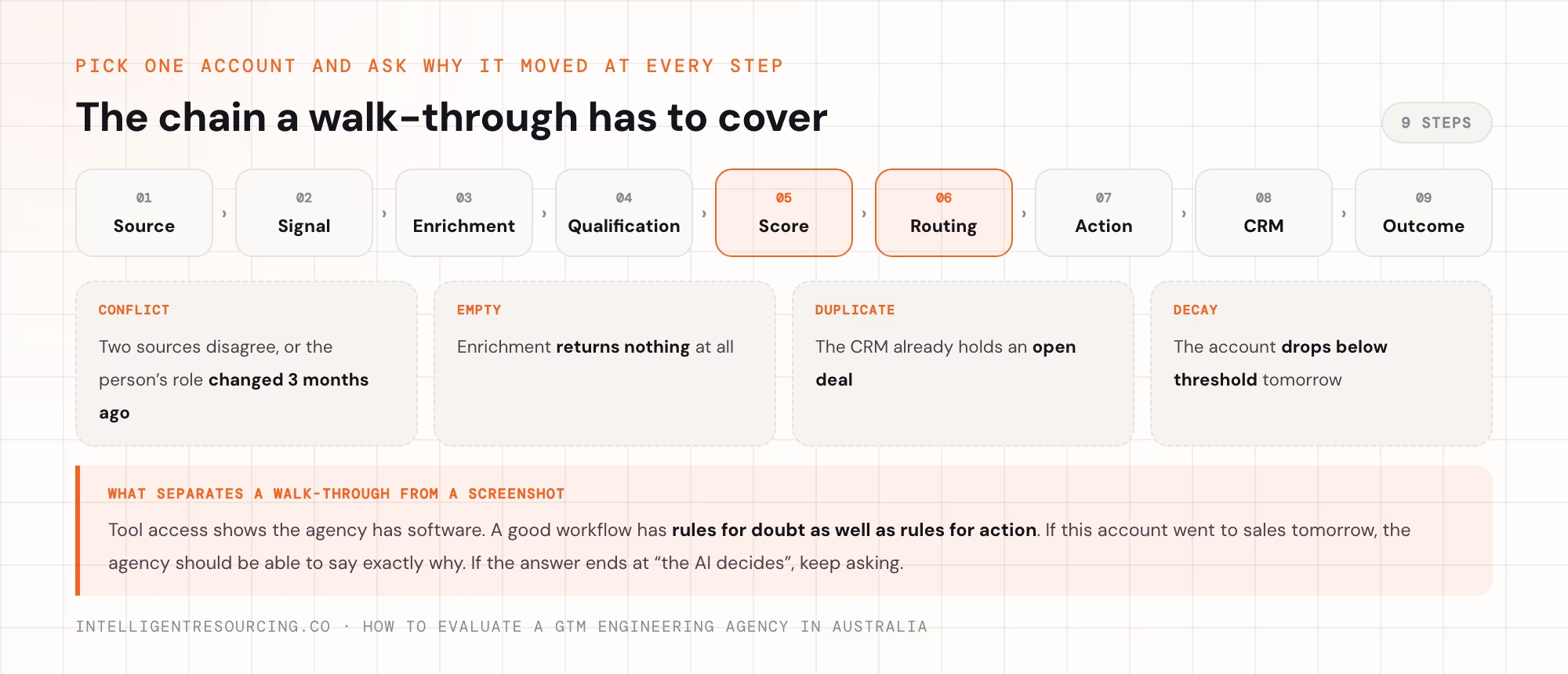
Yes, if the agency lets you follow 1 real or sandbox account through every step, from the first signal to the record written back to your CRM. Ask it to walk the full chain below, then explain why the account moved at each step and what happens when the data fails:
source, signal, enrichment, qualification, score, routing, action, CRM, outcome
Do not settle for screenshots of the agency's workflow tools. Tool access shows the agency has software. It says nothing about whether the logic is sound.
Pick 1 account and ask why it moved:
- What signal entered the system, and which source backed it?
- What data was added, and which rule passed?
- What raised or lowered the score?
- Why did the account go to this salesperson or sequence?
- What record was written back to the CRM?
Then add failure conditions:
- What if 2 sources disagree, or the person's role changed 3 months ago?
- What if enrichment returns nothing?
- What if the CRM already holds an open deal?
- What if the account falls below the threshold tomorrow?
Include a response-time check. In Drift's 2017 test of 433 companies, only 7% replied within five minutes, and 55% had not replied after five business days. The test is old, so treat it as a reason to time your own routing rather than as today's benchmark.
A good workflow has rules for doubt as well as rules for action. If this account went to sales tomorrow, can the agency show exactly why? If the answer ends at "the AI decides", keep asking.
How Should an Australian Company Evaluate Data and Outreach Risk?
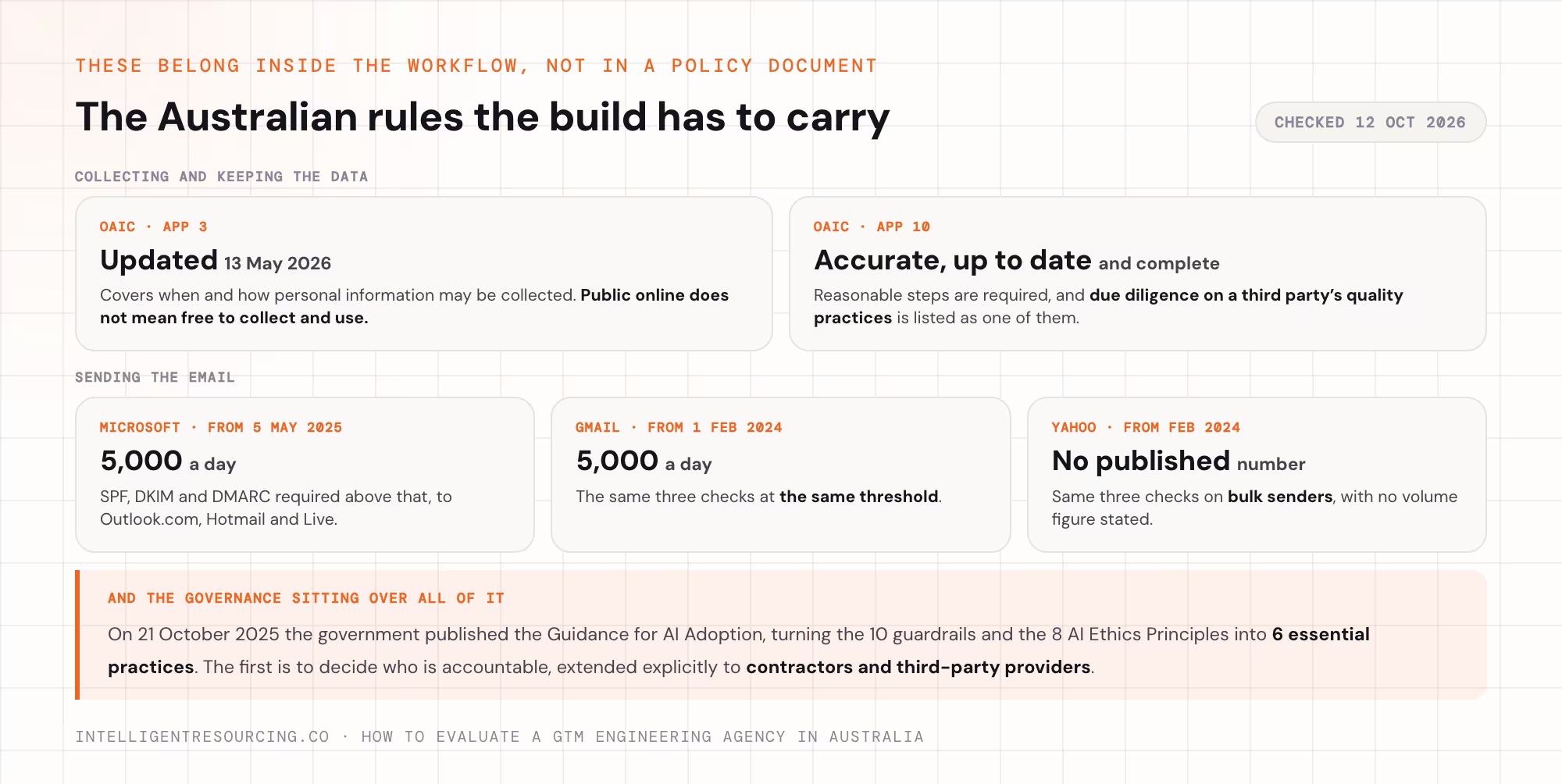
Ask where every piece of prospect data came from and where each outreach rule sits inside the workflow. GTM engineering mixes data collection with automated email, so the Australian Privacy Principles and the email providers' sender rules both need to be built into the design, not left in a policy document.
Ask where the data came from
For firms bound by the Australian Privacy Principles, the OAIC's APP 3 collection guidance covers when and how personal information may be collected. The OAIC updated it on 13 May 2026. Data that is public online is not automatically free to collect and use.
Ask where prospect data starts. Ask whether it comes straight from a source or through a data provider. Ask when it was collected and what happens when it goes stale or is disputed. "Publicly available" should never end the provenance talk.
Ask where outreach controls actually live
The same standard applies when the workflow sends email. Since 5 May 2025, Microsoft has required three email authentication checks from domains sending more than 5,000 emails a day to Outlook.com, Hotmail and Live addresses. The three are Sender Policy Framework (SPF), DomainKeys Identified Mail (DKIM) and Domain-based Message Authentication, Reporting and Conformance (DMARC).
Gmail's bulk sender rules set the same 5,000 a day threshold from 1 February 2024. Yahoo began enforcing the same three checks on bulk senders in February 2024, but publishes no volume number.
So ask to see the workflow. Where is suppression checked? How are unsubscribe requests written back? How is consent status recorded?
Can a suppressed contact re-enter through a new data source? Which system wins when records conflict? "Compliance is handled" is no answer. The agency should show where each rule lives.
Which Red Flags Show Weak Decision Logic?
The clearest red flags are signs that the agency cannot explain or test its own decisions on request. A long list of platforms proves little on its own. Watch instead for scores nobody can explain, sources nobody can trace and reports that count meetings without linking them to signals.
Be cautious when you see any of these:
- A score the provider cannot explain.
- Scoring never tested on past client outcomes.
- Client opinions entering the system without a label.
- Sources and timestamps that cannot be traced.
- Workflow answers that stop at "AI".
- Reports that celebrate meetings without linking them to the signals behind them.
An unexplained score is more than a quality issue. Australia's AI Ethics Principles asked that the people who deploy and run an AI system understand its processes and input data, and that disclosure cover the key factors used in decision making. Those principles now sit inside the Guidance for AI Adoption, and the expectation has not changed.
Some warning signs sit in the contract, such as tools held in the agency's own accounts. Our guide to choosing a GTM partner after raising covers those, and our GTM engineering service page sets out which parts of the build sit in your own stack.
What Should the Agency Be Able to Show Before You Sign?
Before you sign, the agency should show a small evidence pack built from your own records or a sandbox, starting with a historical scoring test and 1 complete evidence trail. Make the final meeting a proof session rather than another capability pitch, and judge the agency on what it can show.
| Ask the agency to show | What you are testing |
|---|---|
| Historical scoring validation | Whether the proposed model relates to your actual deal outcomes |
| One complete evidence trail | Whether account-level claims trace back to sources |
| A labelled client assumption | Whether belief and proof are kept separate |
| A signal-to-action workflow | Whether data, scoring and activation are genuinely connected |
| A conflicting-data example | Whether the system has rules for uncertainty |
| Suppression and unsubscribe logic | Whether governance is built into execution |
| An outcome linked to a trigger or score | Whether the system can learn from its decisions |
You do not need another client's confidential data. A redacted example, a sandbox workflow or a test on your own records shows the method. What matters is whether the provider lets you look at its logic.
If an agency cannot show how it validates, sources, routes and learns before signing, more tools afterwards will not fix that gap.
Keep the pack after you sign. The federal government's draft pilot AI assurance framework asks agencies to maintain reliable records of the decisions, testing and the data assets used in an AI system, so the work can stand up to internal and external scrutiny. It is written for the public sector, but the same habit protects a private buyer too.
GTM Engineering
See how Intelligent Resourcing scores accounts and tracks what the system produces, then book a strategy session.
FAQs
What is a proof session with a GTM engineering agency?
A proof session is a pre-contract meeting where the agency tests its scoring on your decided deals and walks 1 account from signal to CRM record. It also labels which inputs are verified, supplied or inferred. It replaces the final capability pitch.
What should a GTM engineering agency's evidence pack include?
A historical scoring test, 1 complete account evidence trail and a signal-to-action workflow. Add a labelled client assumption and a case where data conflicts. Include the suppression and unsubscribe rules, and 1 outcome linked back to its trigger or score.
How can you tell whether a GTM scoring model is reliable?
Start by testing its logic against deals whose outcomes are already known. The aim is proof that the rules used to rank future accounts match what really happened in your past sales. Perfect retrospective prediction is not the goal.
Why does data provenance matter in GTM engineering?
Automation amplifies its inputs. Labels show which inputs are verified, supplied by you, inferred or tested. With those labels, you can challenge weak assumptions and fix stale data. You can also see why an account got its score or action.
What Australian data issues should be considered when evaluating a GTM agency?
The Australian Privacy Principles may apply to how personal data is collected and kept accurate, depending on your business and workflow. Ask where each data point came from, how it is checked and how stale or disputed records are corrected. Review specific legal obligations with professional advice.