

Why Does an Active Agency Still Fail?

An active agency still fails when its work never reaches the problem it was hired to fix. Emails go out and meetings get booked, but qualified pipeline stays flat. For a funded company, that gap is expensive, because an engagement can keep spending budget while the real problem stays in place.
A comparison of GTM agency models for funded startups can help form a shortlist. The harder question comes after signing: is the engagement making the revenue system better?
What Does Each GTM Metric Actually Prove?
Each GTM metric proves only 1 level of progress. Trouble starts when an early signal is reported as proof of a later result.
| Claim | What it proves | What it does not prove |
|---|---|---|
| The asset exists | The campaign, page or workflow was built | Relevant buyers saw or valued it |
| The system operates | Data moves, messages send and routing works | The targeting or decision logic is right |
| The market responds | Replies, visits or engagement happen | Those responses are qualified |
| Qualified pipeline moves | Relevant accounts become real opportunities | The opportunities will close |
| Revenue follows | Deals close from the motion | The model will stay profitable at scale |
A booked meeting proves that someone agreed to talk. It does not prove the account was right, that there is a live need or that the deal will pass qualification. High send volume proves the system can send, and a strong reply rate proves people reacted.
Qualification is where the gap shows. Ebsta's 2025 Sales Qualification Report, drawn from more than 655,000 business-to-business (B2B) sales opportunities, found well-qualified deals were 6.3 times more likely to win than poorly qualified ones. Its own summary is that top teams win by qualifying well, not by booking more meetings.
Activity is useful for diagnosis. It should not be reported as the final result.
What Are the Most Common Reasons a GTM Agency Engagement Fails?
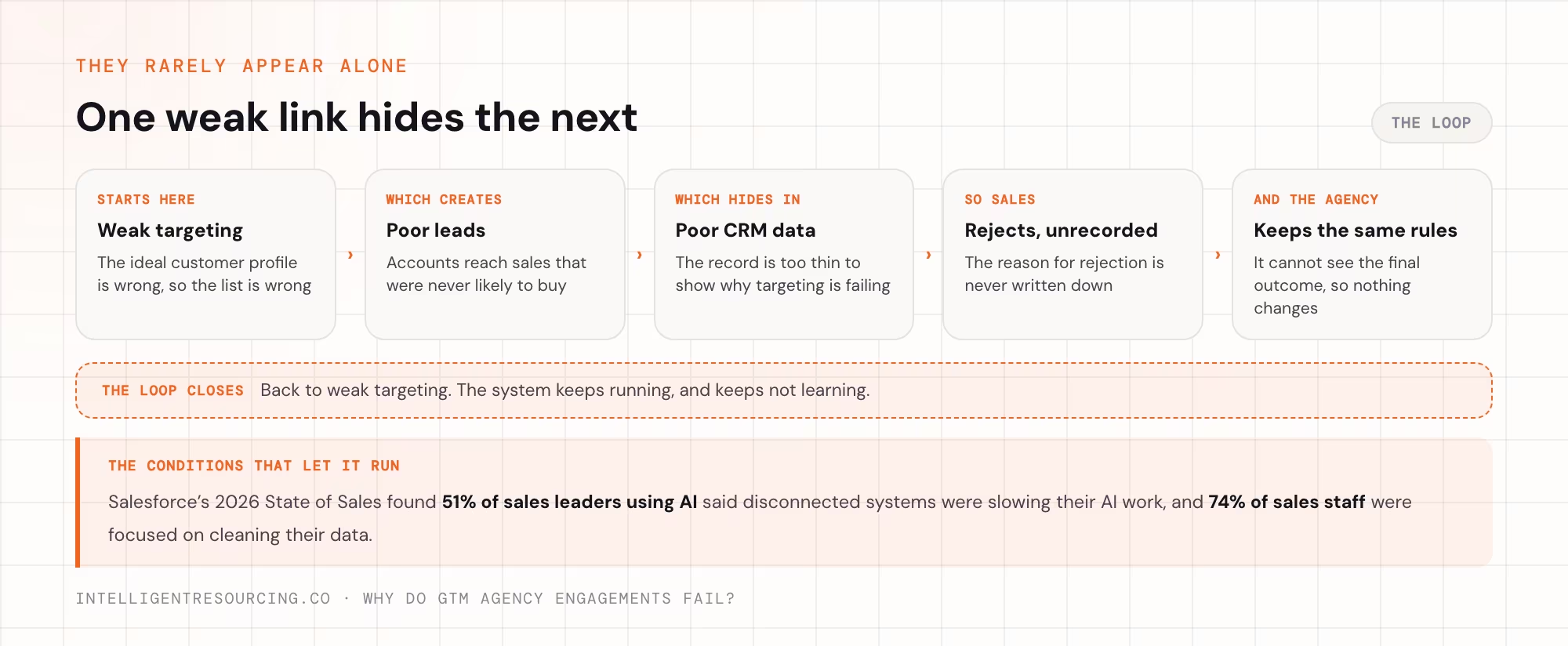
Most GTM agency engagements fail for a few linked reasons. The starting problem is unclear, the two sides measure success differently, targeting is weak, CRM data is poor or sales feedback never comes back. They rarely appear alone. One weak link usually hides the next, so the system keeps running without learning.
These problems often happen together. Weak targeting creates poor leads, and poor CRM data makes the targeting harder to fix. Sales rejects the leads but does not record why. The agency then keeps using the same scoring rules because it cannot see the final outcome.
Poor systems make this worse. Salesforce's 2026 State of Sales findings show that 51% of sales leaders using artificial intelligence (AI) said disconnected systems were slowing their AI work. In the same research, 74% of sales staff were focused on cleaning their data.
When the Agency and Client Measure Different Stages
The agency may be hired to book meetings while leaders expect qualified pipeline. Sales counts accepted deals and finance counts revenue. For example, an agency books 20 meetings and reports a strong month, but sales accepts only 4 as real opportunities and finance sees no new revenue. None of those numbers has to be false.
The fix is to agree on the commercial problem and the success measure before work starts. For the numbers worth tracking each month before revenue lands, see what GTM agency ROI to expect. If the agency is paid for activity while the client expects pipeline, the engagement starts with a built-in conflict.
Why Can Good GTM Execution Still Produce Poor Results?
Good execution still gives poor results when the agency carries out the wrong plan well. Campaigns can launch on time, data can move and reports can be accurate. None of that proves the market, the timing or the offer was right, so strong delivery can sit beside weak revenue.
There are 2 different questions:
- Did the team do the work correctly?
- Was it the right work to do?
A well-built campaign aimed at the wrong accounts is still a weak campaign. The same is true when the target company fits the ideal customer profile (ICP) but has no reason to buy now.
Much of the buying decision also happens away from any campaign. In G2's March 2026 survey of 1,076 B2B software buyers, 69% chose a different vendor than they first planned because of what an AI chatbot told them. A single campaign metric cannot see that part of the journey.
Why Does a Weak ICP Cause GTM Failure?
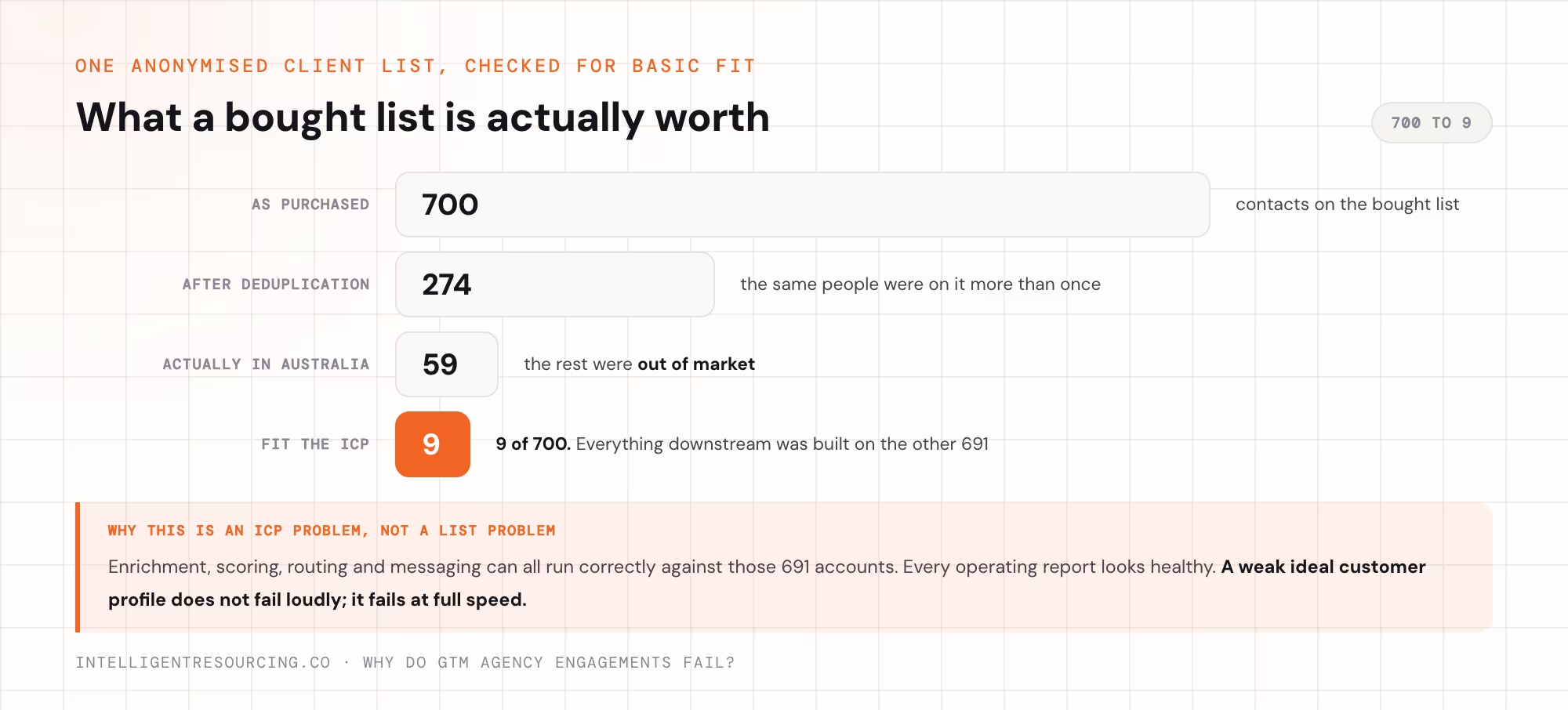
A weak ICP causes GTM failure because every later step acts on it. Enrichment, scoring, routing and messaging can all work correctly while pointing at the wrong accounts. The system then looks healthy on every operating report, while the companies it reaches were never likely to buy.
Intelligent Resourcing has seen how quickly a large prospect list can shrink once basic fit is checked. In one client case, a bought list of 700 contacts fell to 274 after deduplication, 59 were actually based in Australia and only 9 fit the ICP.
A good GTM system should confirm two things: the company fits the ICP, and there is a clear reason to contact it now. If the company does not fit, the target list is weak. If there is no reason to contact it now, the system can automate outreach that arrives before the buyer has any need.
Why Do GTM Workflows Need a CRM Feedback Loop?
GTM workflows need a CRM feedback loop because the CRM is where sales outcomes are recorded. Without that record, the agency can see that an account was contacted or a meeting was booked, but not whether it became a real opportunity. The loop is how the system learns whether its earlier decisions were good.
A connected process should follow the full path:
source, signal, enrichment, score, route, sales action, opportunity, outcome
This is why GTM engineering joins these steps inside one revenue process, from signal to attribution. If sales rejects an account, the reason should feed back into the system:
- If high-scoring accounts become poor opportunities, the score needs to change.
- If one signal keeps producing strong accounts, it may deserve more weight.
- If sales rejects a group of accounts, that reason should feed back into the targeting.
Intelligent Resourcing applies this when testing scoring. In one anonymised client case, Intelligent Resourcing blind-tested its model on 640 already-decided deals. The scoring did not predict which deals would win, but the top-scored accounts were up to 3.6 times more likely to be large deals. It worked as a value filter, not a win predictor.
Australia's Guidance for AI Adoption asks the same of AI systems in general. Its fifth essential practice is to test and monitor them, because a system that worked well last month can behave differently today.
What Causes GTM Automation to Scale the Wrong Decisions?
GTM automation scales the wrong decisions because it runs whatever rules it is given and cannot judge whether they are commercially sound. A weak signal becomes an automatic trigger. A poor ICP becomes a scoring rule. Old CRM data becomes personalisation, and a bad routing rule sends the wrong account to the wrong person faster.
Stale data carries a legal edge too. The Office of the Australian Information Commissioner's guidance on Australian Privacy Principle 10 lists one reasonable step as checking that personal data is still accurate when you use it, above all when it was collected long ago. Automation that personalises from old records can miss that step at scale.
Automation makes a decision happen faster and says nothing about whether it was right.
What Should You Do When a GTM Agency Engagement Is Failing?

When a GTM agency engagement is failing, find the earliest broken stage before you change provider. Check the ICP, the data, the scoring, the CRM routing, the sales feedback and the success measure, in that order. The first stage where the evidence breaks is usually where the fix belongs.
- Check the ICP: are you targeting the right type of company?
- Check the data: is the account and contact information accurate?
- Check the scoring: are high-priority accounts turning into good opportunities?
- Check CRM routing: are leads reaching the right person at the right time?
- Check sales feedback: are rejected accounts recorded with a clear reason?
- Check the success metric: is the agency focused on meetings while the business expects qualified pipeline?
Repair the engagement when the problem is clear and both sides can agree on a change you can test. Replace the provider when it cannot explain weak results, hides how the system works or keeps using activity as proof of success. Our GTM engineering service page sets out how the targeting, scoring and routing stages fit together.
Write down who checks the system and how often. The Guidance for AI Adoption asks buyers to request test methods and results from the provider that built the system, and to set regular reviews that judge whether it is still working. It also expects clear records of decisions, testing and monitoring.
GTM Engineering
See how Intelligent Resourcing scores accounts and tracks what the system produces, then book a strategy session.
FAQs
Can a GTM agency fail even if it books a lot of meetings?
Yes. Meetings prove that people agreed to talk. They do not prove the accounts were qualified, that an opportunity was created or that revenue will follow. Track what happens after each meeting.
How long should you give a failing GTM agency?
There is no single safe timeline. Review whether the agency has enough data to diagnose the issue, whether it can explain the failure and whether agreed changes improve the next stage of the funnel. Time alone is no proof that the engagement will improve.
Is the agency always responsible when GTM results are poor?
No. The problem can sit with the agency, the client or the system between them. Weak positioning, slow sales follow-up, bad CRM data or unclear rules for what counts as qualified can all hurt results, even when the agency does its job well.
What is the clearest sign that a GTM agency engagement is failing?
One strong warning sign is reports that stay focused on activity while the next commercial stage does not improve. If emails, leads or meetings keep rising but qualified pipeline stays flat, find the gap between those stages.