

What Is the Core Difference Between Funded and Bootstrapped Go-to-Market?
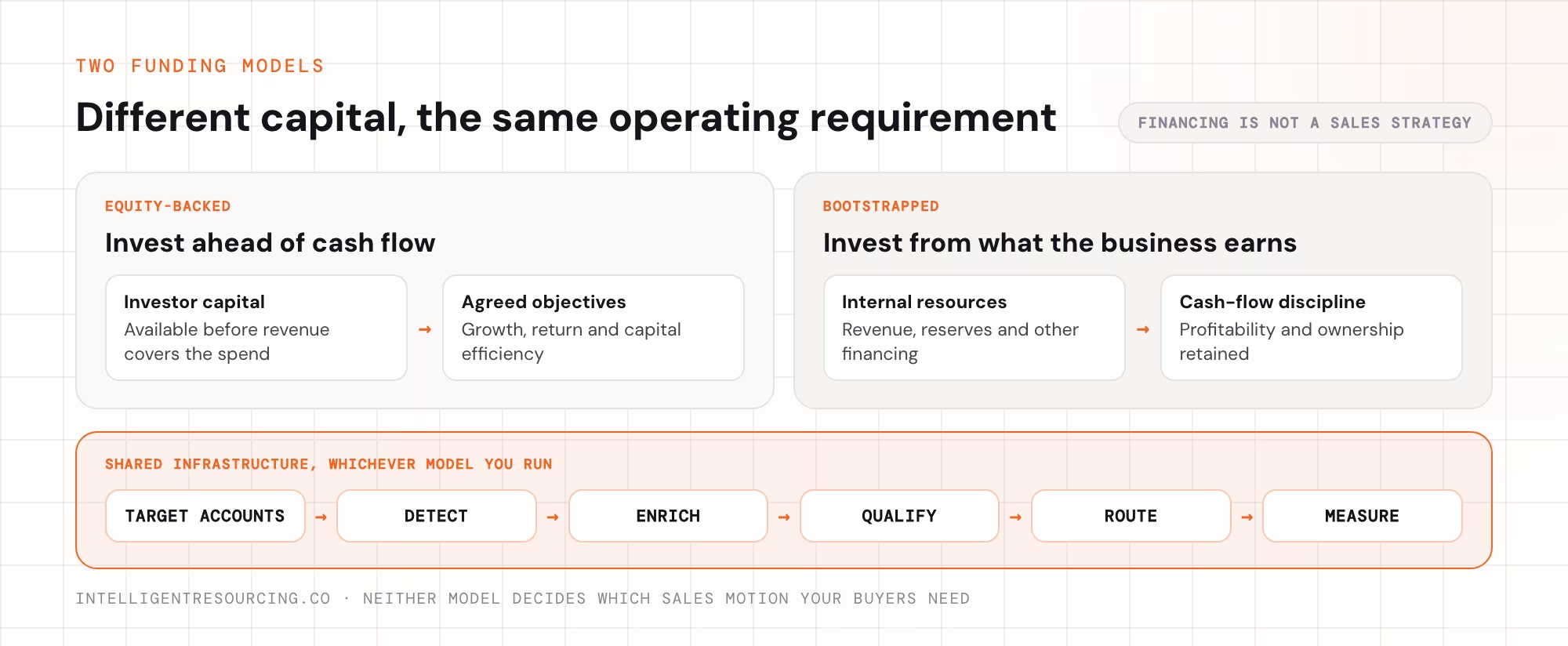
The core difference in go-to-market (GTM) is financial, not operational: how each business finances growth and manages the risks of expansion. Equity-backed startups can deploy investor capital before operating cash flow supports additional spending. Bootstrapped companies generally depend more on customer revenue, accumulated reserves and other internally managed resources. Both must eventually demonstrate that customer acquisition creates sustainable commercial value.
A funded startup may invest in additional sales capacity, data infrastructure or new markets before those activities generate enough revenue to cover their costs. A bootstrapped startup may make similar investments, but available cash, profitability objectives and financing commitments place tighter limits on timing and scale.
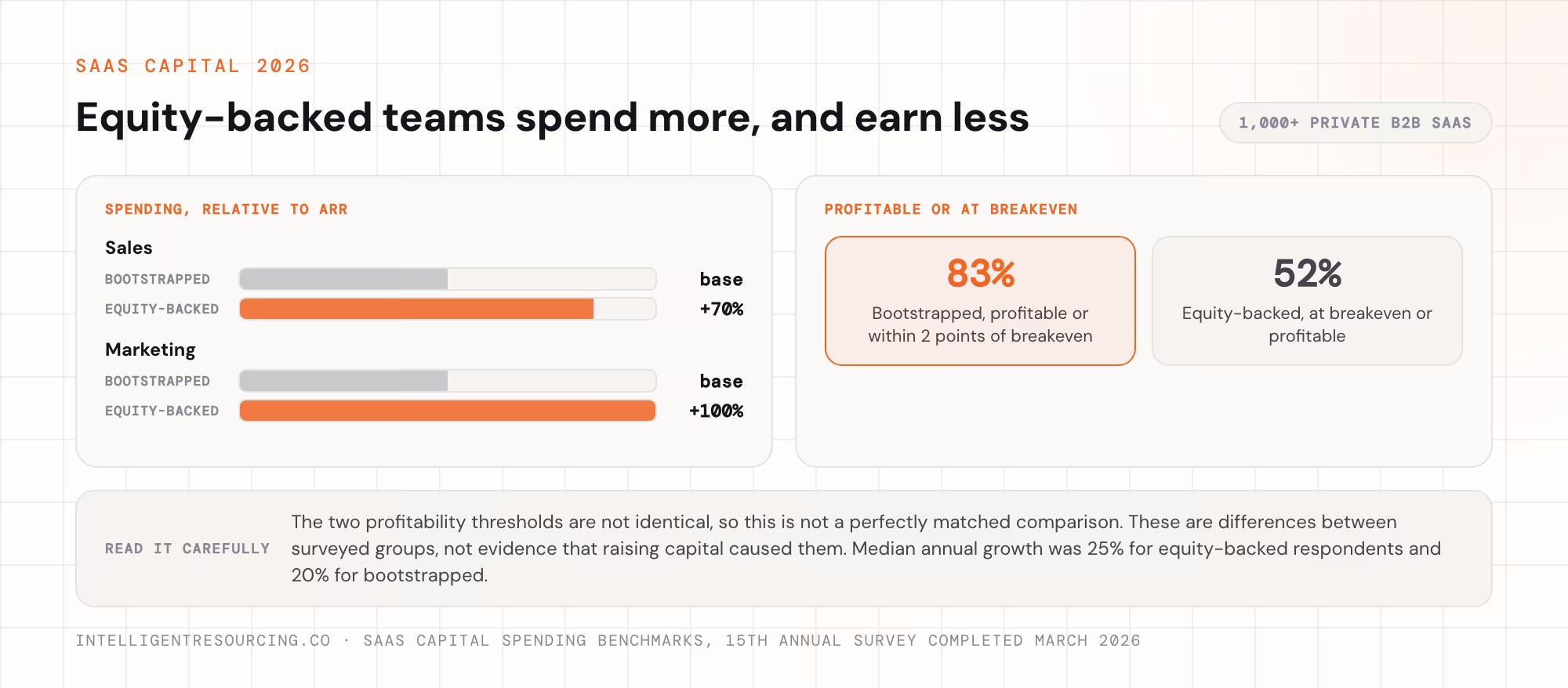
What does the latest SaaS research show? SaaS Capital's 2026 spending benchmarks, based on responses from more than 1,000 private business-to-business (B2B) SaaS companies, found differences in profitability and departmental spending between bootstrapped and equity-backed respondents.
Among bootstrapped respondents, 83% were profitable or operating within two percentage points of breakeven. Among equity-backed respondents, 52% were at breakeven or profitable. The profitability thresholds are not identical, so the figures should not be treated as a perfectly matched comparison.
The research also found that equity-backed companies reported spending 70% more on sales and 100% more on marketing, measured as proportions of annual recurring revenue (ARR).
| Measure | Equity-backed SaaS companies | Bootstrapped SaaS companies |
|---|---|---|
| Main funding characteristics | Have raised equity capital | Have not relied on institutional equity funding for the business |
| Profitability measure | 52% at breakeven or profitable | 83% profitable or within two percentage points of breakeven |
| Sales spending | 70% higher relative to ARR | Comparison baseline |
| Marketing spending | 100% higher relative to ARR | Comparison baseline |
| Median annual growth in the survey | 25% | 20% |
These are comparisons between surveyed groups. They do not establish that receiving investment caused higher spending, different profitability or faster growth.
What it means for GTM. A funded company can have greater capacity to test channels, acquire technology or build a sales organisation before those investments pay back, while a bootstrapped company may place more emphasis on near-term cash generation and the cost of expanding operations. Neither should treat available capital as proof that additional activity will produce a qualified pipeline.
Where they meet. Both need to identify suitable accounts, understand buying behaviour and measure whether sales activity produces valuable outcomes. For companies evaluating external implementation support, comparing GTM agencies for funded startups should involve examining how providers handle account qualification, customer relationship management (CRM) integration, sales workflows and performance measurement, not simply how much activity they promise.
How Do Growth Targets and Timelines Differ?
Funded and bootstrapped startups often face different growth expectations and planning constraints. Equity-backed companies typically agree performance objectives with investors and boards, while bootstrapped founders generally have greater discretion over investment pace. Neither model follows a universal timetable, and growth targets should reflect cash availability, customer demand, sales-cycle length and financing commitments.
Funding can create pressure to demonstrate progress within a defined period, particularly when a company expects to raise another round, although not every funded company must raise again: some pursue profitability, acquisition, alternative financing or a different operating plan. Bootstrapped companies face their own deadlines, since debt repayments, customer commitments, competitive pressures and cash shortages can require rapid decisions without an investor-imposed fundraising timetable.
How do investor expectations affect GTM planning? CRV's 2026 Series A metrics guide says the ARR benchmark for a competitive Series A raise in B2B SaaS generally starts at US$2 million to US$5 million. This is one investor's guidance for the United States market, not a universal eligibility threshold, and expectations vary by market, business model, growth, retention and financing conditions.
For a company pursuing that type of round, GTM planning may need to demonstrate more than increasing revenue. Investors may also examine customer acquisition costs, retention, repeatable sales execution and the efficiency of further investment.
| Dimension | Funded startup | Bootstrapped company |
|---|---|---|
| Who influences targets | Founders, management, board and investors | Founders, management and financial stakeholders |
| Planning constraints | Runway, investor expectations, operating performance and possible financing milestones | Cash flow, reserves, financing obligations and operating priorities |
| Channel investment | Can test several initiatives when capital and capacity support them | May prioritise fewer initiatives when resources are constrained |
| If growth disappoints | May revise spending, hiring, targets or financing plans | May revise spending, hiring, targets or financing plans |
| Evidence needed before scaling | Repeatable acquisition and acceptable growth economics | Repeatable acquisition and acceptable growth economics |
What it means for GTM. Funded companies may choose to test multiple acquisition channels in parallel because their operating budgets allow it, while bootstrapped companies may prefer smaller tests to limit financial exposure. The distinction should rest on actual capacity, not an assumption that funded companies must move quickly or that bootstrapped businesses can afford to wait indefinitely.
Where they meet. Both should establish what a successful channel test means before increasing investment, using evidence such as qualified opportunities, opportunity conversion, customer acquisition cost, payback period and the ability to repeat results without excessive founder intervention. These checks also help identify the premature hiring, targeting and campaign-expansion problems described in the post-funding growth playbook.
How Do Investors and Founders Judge GTM Efficiency?
Funded and bootstrapped companies both need to understand whether growth justifies its cost. Equity-backed businesses may use burn multiple to assess cash consumption relative to new recurring revenue, while bootstrapped founders often emphasise operating cash flow and profitability. Both should examine customer acquisition cost (CAC), gross margins, retention and the resources required to generate revenue.
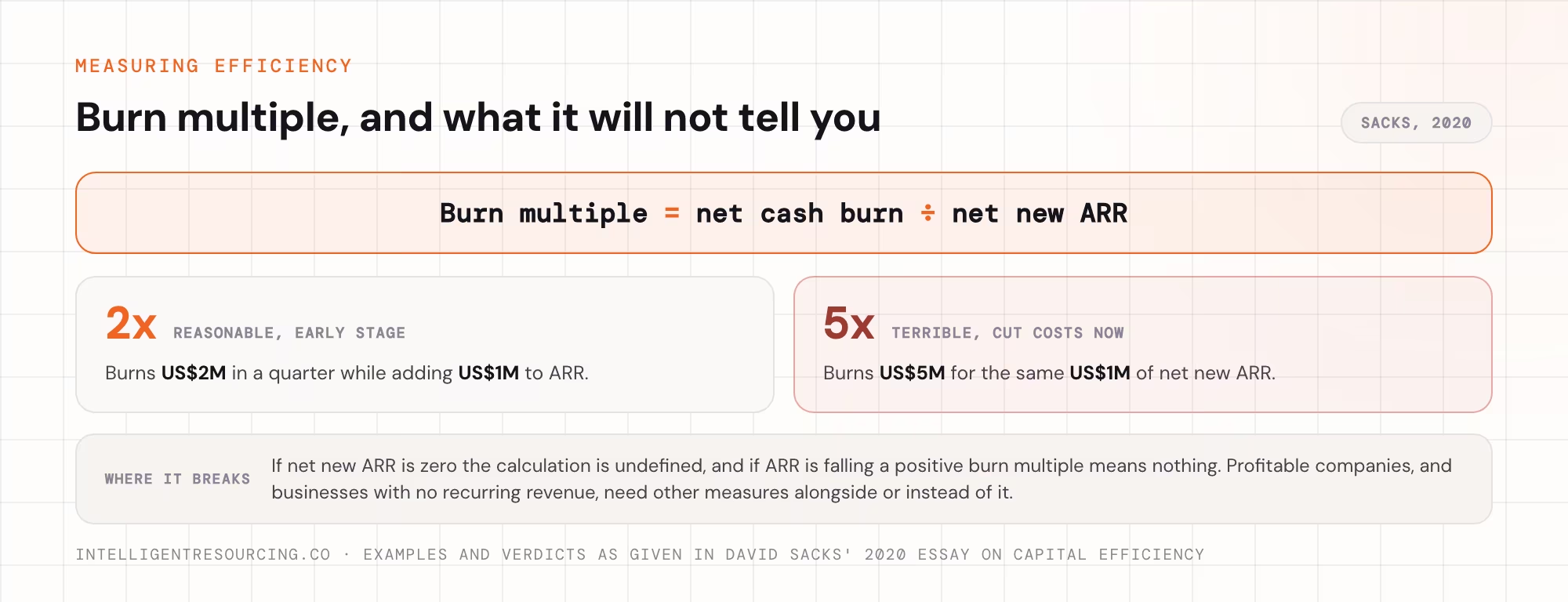
How does burn multiple work? Investor David Sacks introduced the burn multiple in his 2020 essay on capital efficiency. The measure compares net cash burn with net new ARR over the same reporting period, after accounting for relevant changes such as expansion, contraction and churn. Burn multiple is net cash burn divided by net new ARR.
Sacks gives two worked examples. A startup that burns US$2 million in a quarter while adding US$1 million to ARR has a 2x burn multiple, which he calls reasonable for an early-stage startup. A startup that burns US$5 million to add the same US$1 million of net new ARR has a 5x burn multiple, which he calls terrible and a signal to cut costs immediately.
The measure has real limitations: if net new ARR is zero, the calculation is undefined, and if ARR is declining, a conventional positive burn multiple gives no useful interpretation. Profitable companies or businesses without recurring revenue may need other measures alongside or instead of it.
| Measure | Funded startup | Bootstrapped company |
|---|---|---|
| Net cash burn | Helps assess cash consumption and runway | Useful when cash flow is negative |
| Burn multiple | Relevant when net cash burn and positive net new ARR can be measured | Relevant under the same conditions |
| Operating cash flow | Shows financing requirements and sustainability | Central to available investment capacity |
| Customer acquisition cost | Assesses the cost of acquiring customers | Assesses the cost of acquiring customers |
| CAC payback period | Helps evaluate how quickly acquisition spending is recovered | Helps evaluate how quickly acquisition spending is recovered |
| Retention | Tests revenue durability and future growth | Tests revenue durability and future growth |
What it means for GTM. Sales hiring is one possible source of rising acquisition costs, but it is not necessarily the largest expense for every startup: engineering, infrastructure, regulatory requirements and product development can also require substantial investment. A funded business needs to assess total cash requirements as well as sales efficiency, while a bootstrapped business should account for founder time, staffing costs and other resources even when those expenses do not appear as large cash outflows.
The economics of building versus outsourcing after funding depend on those full costs, the company's internal expertise and whether external support creates lasting capabilities.
Where they meet. Both models benefit from reducing work that does not contribute to qualified opportunities or customer value. Improving account selection, eliminating duplicate research and reducing missed sales handoffs can support capital efficiency without assuming that every business must follow the same growth target.
How Do Sales Motions Differ Between the Two?
Funded and bootstrapped startups can use the same sales motions: founder-led selling, account executives, partners, product-led acquisition or combinations of these approaches. Funding affects how much capacity a company can add, but it does not determine which motion customers need. Product complexity, contract value, buyer preferences and acquisition economics remain the main design considerations.
A funded company can operate a self-service product with limited direct sales involvement, just as a bootstrapped company can build an enterprise sales team when its economics and cash resources support one. The relevant distinction is how much investment each business can sustain while establishing or expanding the chosen motion.
What does Atlassian illustrate? Australian software company Atlassian provides a historical example of a business that scaled an online distribution model before raising a major venture investment. A 2015 SmartCompany profile of Atlassian reported that the company brought in about US$1.3 million in 2003 and took a US$60 million investment from Accel in 2010, emphasising transparent online product information, low-friction purchasing and automation rather than a traditional cold-calling operation.
This is a historical example of one company's business model, not proof that bootstrapping causes product-led success or that other startups should reproduce its sales structure.
| Dimension | Funded startup | Bootstrapped company |
|---|---|---|
| Founder-led sales | Possible at early stages | Possible at early stages |
| Sales-assisted acquisition | Investment depends on resources and unit economics | Investment depends on resources and unit economics |
| Product-led acquisition | Appropriate where buyers can evaluate and purchase independently | Appropriate under the same conditions |
| Channel experimentation | May support broader simultaneous testing | May prioritise a smaller number of tests |
| Main implementation risk | Increasing spending before confirming repeatability | Underinvesting in systems or capacity needed for repeatability |
What it means for GTM. A startup should choose its sales motion based on how customers evaluate and purchase the product: higher-value, complex purchases may require account executives and technical support, while products with straightforward onboarding and purchasing may support self-service evaluation. Neither outcome follows automatically from the company's funding structure.
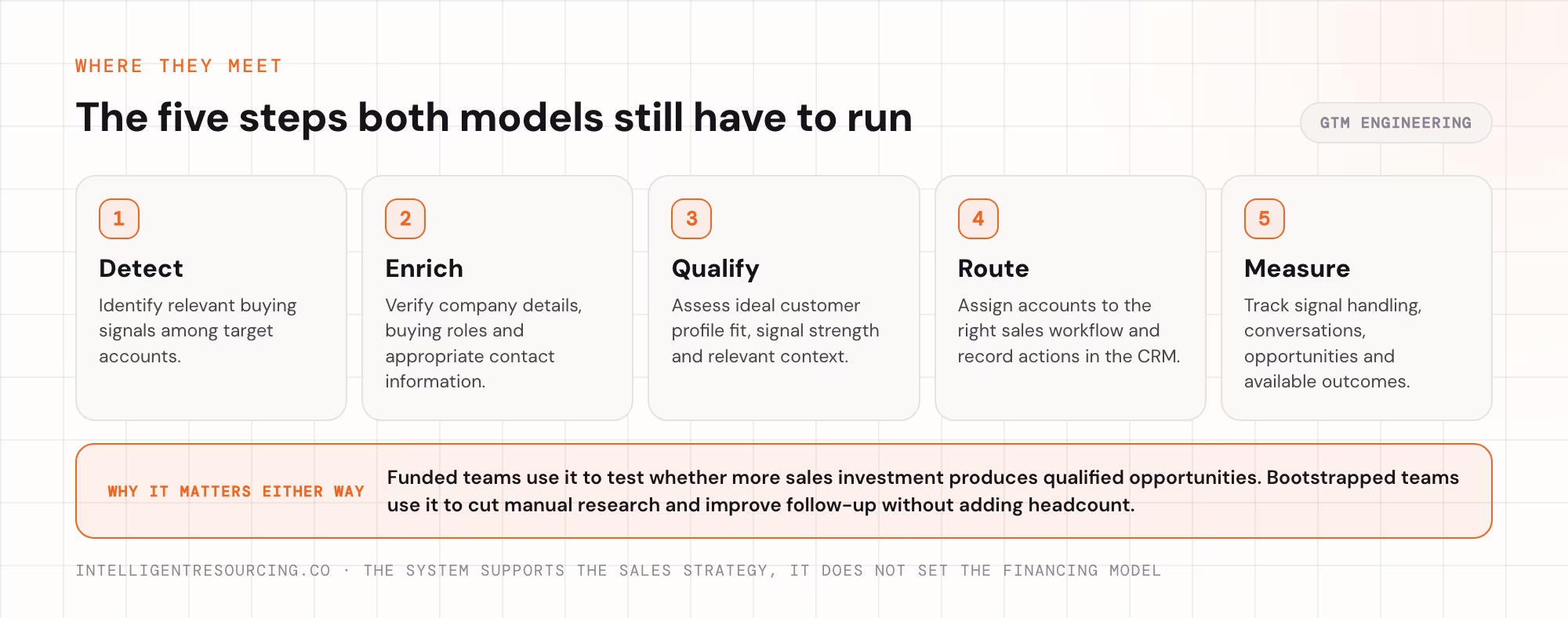
Where they meet. Both models need reliable information about which accounts matter, what has changed within those accounts and what sales should do next. A GTM Engineering system connects five operational steps:
- Detect. Identify relevant buying signals among target accounts.
- Enrich. Verify company details, buying roles and appropriate contact information.
- Qualify. Assess ideal customer profile (ICP) fit, signal strength and relevant context.
- Route. Assign suitable accounts to the correct sales workflow and record actions in the CRM.
- Measure. Track signal handling, conversations, opportunities and available outcomes.
Funded companies can use this infrastructure to assess whether increased sales investment produces qualified opportunities. Bootstrapped companies with sales-assisted models can use it to reduce manual research and improve follow-up without automatically adding headcount. The approach supports the customer's sales strategy rather than determining its financing model.
What Changes When a Bootstrapped Company Raises?
When a bootstrapped company raises equity capital, it gains additional investment capacity and may accept new governance, reporting and growth commitments, but its established sales motion does not automatically need replacing. The practical challenge is deciding which parts of the existing process can scale, which need more resources and which assumptions require testing. The change can affect hiring, technology investment, market expansion and the amount of financial risk the company is prepared to accept, but raising capital does not require every business to adopt high-volume outbound, a traditional enterprise sales team or multiple new acquisition channels.
What does Atlassian's transition show? Accel's Atlassian company profile records its initial investment as a Series A round in 2010, by which stage Atlassian had already developed the online distribution model described earlier. Its experience illustrates the distinction between financing an established business and inventing an entirely new acquisition process after receiving investment.
| Dimension | Before raising | After raising |
|---|---|---|
| Available capital | More dependent on operating resources and existing financing | Includes newly raised equity capital |
| Governance | Determined by existing ownership and company arrangements | May include new investor rights, reporting and board responsibilities |
| GTM investment | Limited by established cash and financing capacity | May support additional hiring, technology or market expansion |
| Main operational question | Which acquisition activities work within available resources? | Which proven activities can absorb additional investment effectively? |
| Main risk | Insufficient capacity to support valuable opportunities | Expanding spending without evidence of repeatability |
What it means for GTM. The first task after a raise is to establish which parts of the existing acquisition process already work, by examining customer segments, conversion rates, sales-cycle length, acquisition costs and the level of founder involvement. Additional investment should be connected to specific operational requirements, such as improving data quality, expanding qualified account coverage or fixing sales routing.
Where they meet. The discipline of measuring channel economics remains useful before and after raising. New capital changes the range of available choices, but it does not make weak qualification rules, poor CRM data or unclear follow-up responsibilities less important.
Which GTM Model Fits Your Company Right Now?
The appropriate financing approach depends on the company's capital requirements, commercial evidence, ownership preferences and financial obligations. Market speed and sales-cycle length matter, but neither determines the answer alone. Founders should examine whether their existing acquisition process works, how much expansion costs and whether available resources support the intended pace of growth.
Australia's funding environment provides useful context, although it cannot determine an individual company's financing decision. Cut Through Venture and Folklore Ventures' State of Australian Startup Funding 2025, published on 3 February 2026, recorded A$5.4 billion in announced funding across 390 deals during 2025, a 31% increase in total capital raised year on year and the third-largest funding year on record. The report describes the recovery as selective, with a small number of mega rounds lifting the headline total: deals above A$50 million fell from 21 in 2024 to 15 in 2025. None of this establishes that equity financing is available or appropriate for every startup.
What should founders check before changing their growth model? Use the following questions to assess the business:
- Is the GTM process repeatable? Can the team consistently identify qualified accounts and progress opportunities without relying entirely on founder involvement?
- What does expansion actually cost? Include hiring, onboarding, technology, customer support and working capital rather than considering media spend alone.
- How long does customer acquisition take to pay back? Compare acquisition costs with gross margin, retention and realistic sales-cycle assumptions.
- Can existing systems handle greater demand? Review data quality, buying signals, qualification rules, routing and response completion.
- What financial flexibility remains? Assess cash reserves, net burn, debt commitments, expected revenue and the potential obligations of external investment.
| Diagnostic question | Evidence to review |
|---|---|
| Is acquisition repeatable? | Conversion, win rates and opportunity outcomes without routine founder intervention |
| What is the expansion cost? | Fully loaded staffing, systems, onboarding and working-capital requirements |
| When is acquisition spending recovered? | CAC, gross margin and payback period |
| Are buying signals actionable? | Data completeness, ICP qualification, routing accuracy and response times |
| Can the company finance the plan? | Cash reserves, financing obligations, net burn and realistic runway |
These measures help distinguish a funding constraint from an execution problem: a company may have adequate capital but weak customer targeting, or a repeatable acquisition process but insufficient resources to expand it, and those situations require different decisions.
What it means for GTM. Funding decisions and operational decisions should be evaluated separately. More capital can support additional investment, but it cannot establish product-market fit or turn unqualified accounts into suitable buyers, just as careful spending does not guarantee a company has enough capacity to pursue every worthwhile opportunity.
Where they meet. Whether a company is funded or bootstrapped, its sales-assisted GTM system should help answer the same operational questions:
- Which accounts match the intended customer profile?
- What credible buying signals are available?
- Which accounts warrant further qualification?
- Who should take action, and when?
- Which signals and workflows are producing meaningful commercial outcomes?
A connected system makes those answers easier to track and improve without requiring the business to change its financing model.
GTM Engineering
Whether your business is funded or bootstrapped, Intelligent Resourcing helps B2B teams connect buying-signal detection, account enrichment, lead scoring and CRM workflows so sales can act on relevant opportunities without relying on disconnected processes.
FAQs
What is the main difference between funded and bootstrapped GTM?
The main difference is how growth is financed and what financial constraints shape investment decisions. Equity-backed startups can deploy investor capital ahead of operating cash flow, while bootstrapped companies rely more on revenue, reserves and other available resources. Neither funding model automatically determines the company's sales motion, growth rate or profitability.
Do funded startups spend more on sales and marketing?
In SaaS Capital's 2026 survey of more than 1,000 private B2B SaaS companies, equity-backed respondents reported spending 70% more on sales and 100% more on marketing than bootstrapped respondents, measured relative to ARR. These are observed differences between surveyed groups, not a spending requirement or proof that equity financing caused the gap.
Can a bootstrapped company compete with a funded rival?
Yes. A bootstrapped company can use clear positioning, strong customer economics, suitable distribution channels and efficient sales systems without matching a rival's spending. However, its ability to expand depends on resources, customer demand and market requirements. Atlassian provides a historical example of substantial growth before major venture investment, not a universal model.
When should a bootstrapped company consider raising funding?
A bootstrapped company can evaluate equity funding when its expansion requirements exceed available internal resources and additional investment has a credible commercial purpose. Relevant considerations include acquisition repeatability, customer economics, market conditions, ownership dilution, investor commitments and alternative financing options. Raising capital changes available resources but does not establish that the GTM process works.