

What Is the Difference Between CRM Data Cleansing and Enrichment?
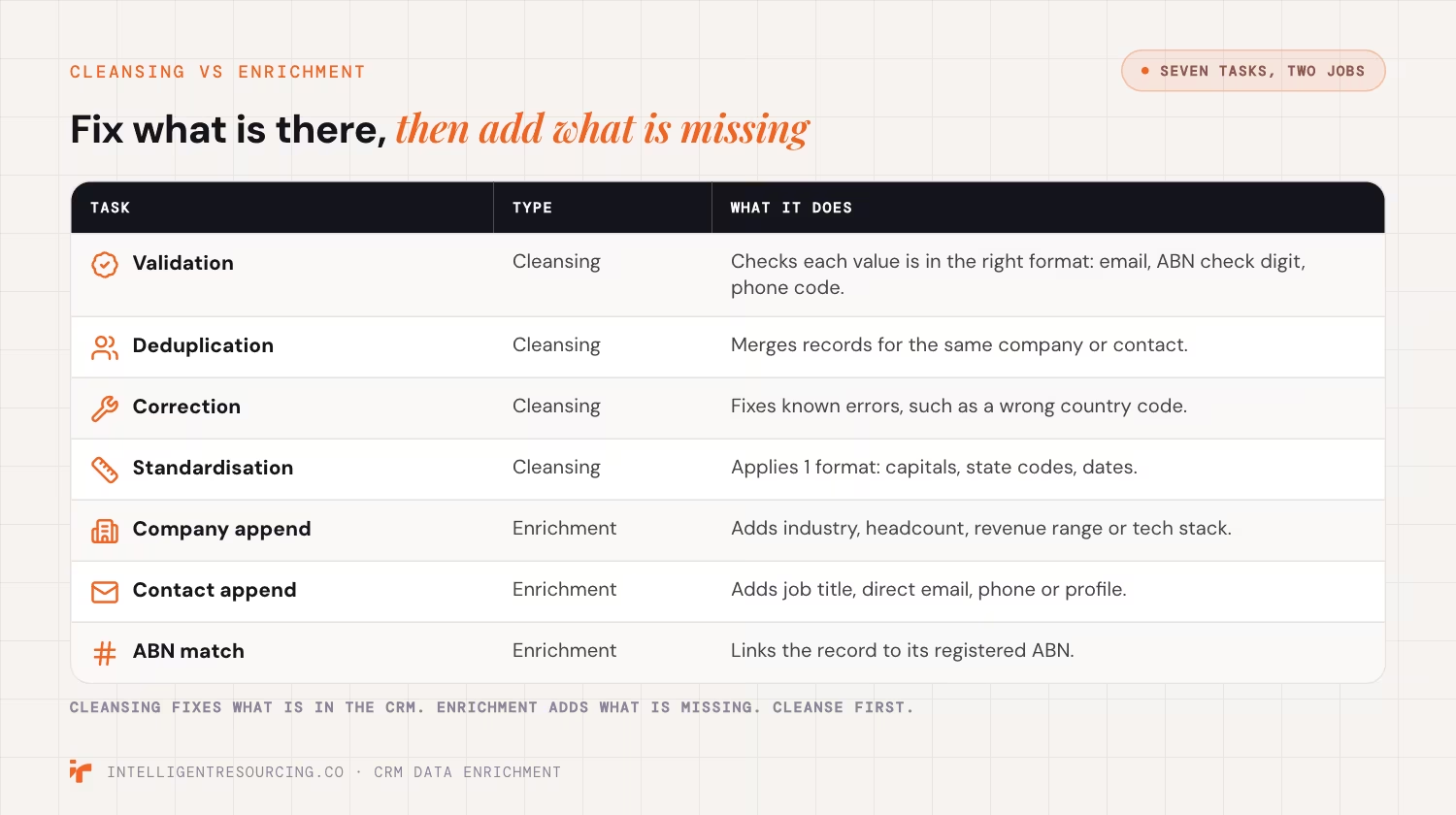
Cleansing fixes what is in your CRM, and enrichment adds what is missing. Cleansing covers validation, deduplication, correction and standardisation. Enrichment appends attributes from outside, such as company size or job title. Assess records first, because enrichment on a duplicate or invalid record spreads the error.
Cleansing tasks include:
- Validation. Checks that a field value is in the right format: an email address, an ABN with the correct check digit, a phone number with a valid country code.
- Deduplication. Finds and merges records that represent the same company or contact. Two entries for 1 account double the calls and halve the picture.
- Correction. Fixes known errors: a wrong phone country code, "Pty Ltd" written 1 way in half the records and another way in the rest.
- Standardisation. Applies 1 format across all records: capitalisation, state codes, date formats, field naming.
Enrichment tasks include:
- Company append. Adds industry, employee count, revenue range or technology stack from an external source.
- Contact append. Adds job title, direct email, phone or LinkedIn profile for a named individual.
- ABN match. Links a company record to its registered ABN, which unlocks registry data from the Australian Business Register.
How Do Australian B2B Teams Enrich Existing CRM Records?
Match each company to its ABN first, then append contact and company fields conditionally, and record the source and date on every value. The steps below suit most CRMs, though each CRM and provider supports different features, so check what yours can do.
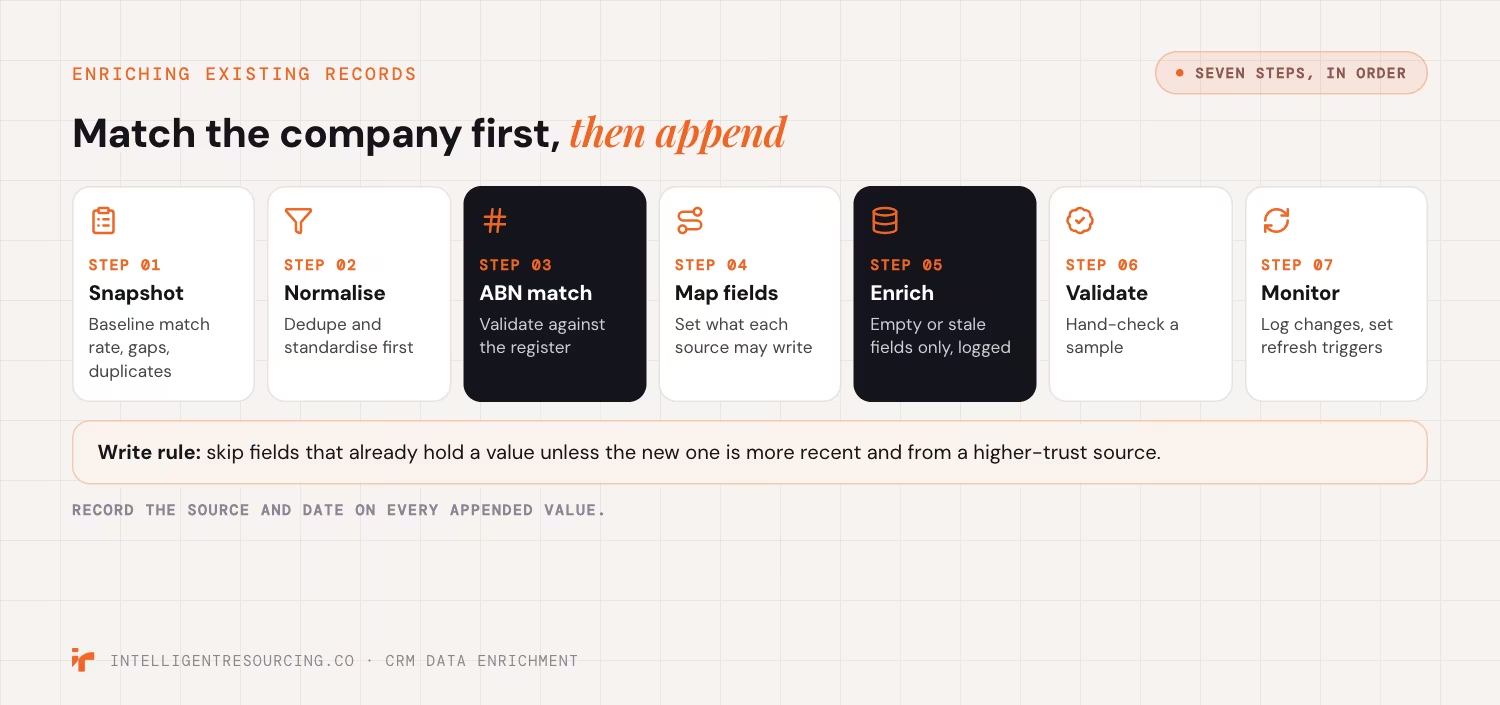
Step 1. Snapshot and baseline. Export a record sample before touching anything. Count current match rates, completeness and duplicates. This is the baseline for return on investment (ROI) measurement later.
Step 2. Normalise first. Run deduplication and field standardisation before connecting any enrichment source. Adding data to duplicates multiplies the problem.
Step 3. Match each company to its ABN. Use the ABN Lookup web services to validate against the Australian Business Register. Registration and an authentication globally unique identifier (GUID) are required. The service is free and returns registered name, entity type, GST status and state.
Step 4. Map fields before connecting. Decide which fields the enrichment source can write to and under what conditions. Field mapping and write rules decide whether enrichment overwrites confirmed data. The prospecting tool integration guide covers CRM-specific configuration.
Step 5. Run enrichment conditionally. Append only to empty or outdated fields. Set write rules to skip fields that already hold a value unless the incoming data is explicitly more recent and from a higher-trust source. Log the source and timestamp on every appended value.
Step 6. Validate the output. Check a sample of enriched records manually. Count the verified contact rate: how many of the enriched records have a usable, reachable contact? Compare this to the pre-enrichment baseline. Set pass conditions for an enrichment pilot before the run, not after it.
Step 7. Monitor. Log changes and set refresh triggers so the team knows when records go stale. ABN data identifies a business and says nothing about a person.
How Should You Compare B2B Data Enrichment Providers, Local or Global?
Compare providers on your own records, using the same sample and the same criteria. Local and global platforms can each suit an Australian team. Nothing in the sources reviewed shows that global platforms perform worse here, so ask every provider for evidence on your data.
The Australian and Asia-Pacific (APAC) data accuracy comparison covers provider-specific results in this region. The criteria below apply to any shortlist.
Questions to ask every provider before buying:
| Criterion | What to ask |
|---|---|
| Match rate | What percentage of your sample records does the provider match? |
| Accuracy | Of the matched records, how many are verified as correct? |
| Freshness | When was each matched record last updated? |
| Coverage | What percentage of Australian companies and contacts are in the dataset? |
| Compliance | Can the provider support opt-out and consent workflows for Australian recipients? |
| Write rules | Can it skip, append or overwrite based on field conditions? |
Australian law applies to commercial electronic messages sent to Australian recipients. Check that any provider can support the consent and opt-out workflows required by the Spam Act 2003 before building outreach from enriched contact data. The same applies when the data includes names, direct emails or phone numbers, which are personal information under the Privacy Act.
How Much Does B2B Data Enrichment Cost in Australia?
Costs come from 5 models, and few providers publish an Australian-dollar price. Subscriptions, credits, per-record fees, API usage and implementation time all add up. Compare the cost per usable record and look past the headline plan price. As at 30 October 2026, request written quotes on the same test records.

The 5 cost models:
- Subscription. A flat monthly or annual fee for access to the provider's dataset, typically with a record or credit limit.
- Credits. A pre-purchased block that depletes with each enrichment action. Unused credits often expire.
- Per-record fee. A charge applied only when a field is successfully matched and written.
- API usage. Metered billing based on the number of API calls, regardless of whether the call returns a match.
- Implementation time. The internal cost of configuring field maps, write rules, testing and ongoing maintenance. Rarely included in vendor quotes.
Verified public examples, checked on 30 October 2026:
- Apollo: Apollo's pricing page lists Free, Basic, Professional and Custom plans. One pool of credits covers emails, phone numbers and other data, credits reset each billing cycle, and limits vary by plan.
- Clay: Clay's pricing page shows a free plan with 100 data credits and 500 actions a month, and paid plans from US$167 per month billed annually (US$185 month to month). Enrichment uses data credits for vendor data and actions for platform work, and a lookup that returns no result is not charged.
- ZoomInfo: ZoomInfo does not list prices publicly. Request a quote for Australian team sizing.
- HubSpot: HubSpot's knowledge base says data enrichment does not consume HubSpot Credits. It is available on Starter, Professional and Enterprise subscriptions, while smart properties do use credits.
Count cost per usable record: the verified, reachable, correctly routed record. Do not count cost per credit consumed.
How Often Should Australian Businesses Refresh Enriched CRM Data?
Refresh when something changes and on a schedule matched to how you use each record. No verified industry standard exists for this interval, so match it to the risk: a record used monthly needs monthly checks, and a record used annually can wait. Trigger-based refreshes cost less than blanket ones.
Trigger-based refreshes (recommended as the primary method):
- Company changes its ABN status or registered name
- Contact changes role or leaves the company (email bounce, out-of-office pattern, LinkedIn update)
- Account enters a new segment or crosses a revenue threshold
- Pre-campaign: re-validate records in scope before any outreach run
Schedule-based refreshes (secondary, for records not in active use):
| Record type | Suggested interval |
|---|---|
| Active pipeline accounts | Monthly |
| Ideal customer profile (ICP) accounts not yet in pipeline | Quarterly |
| Historical or cold accounts | Every 6 months or on trigger only |
| ABN and company records | On trigger: check registry for status changes |
The Australian Securities and Investments Commission (ASIC) publishes its company dataset on data.gov.au weekly, every Tuesday.
For connecting refresh triggers to outreach timing, see the signal-led prospecting system guide.
Many CRMs also offer native enrichment that copies fields from a vendor dataset, which is a different job from verifying a business identity. Check what yours does before purchasing a separate enrichment tool.
How Can a Team Keep Enriched CRM Data Tied to Buying Timing?
Keep enriched data useful by linking each record to a segment and a trigger that tells sales when to act. Accurate records only pay off when someone uses them at the right time. A team that cleans, matches and refreshes data still needs a routine that turns changes into outreach.
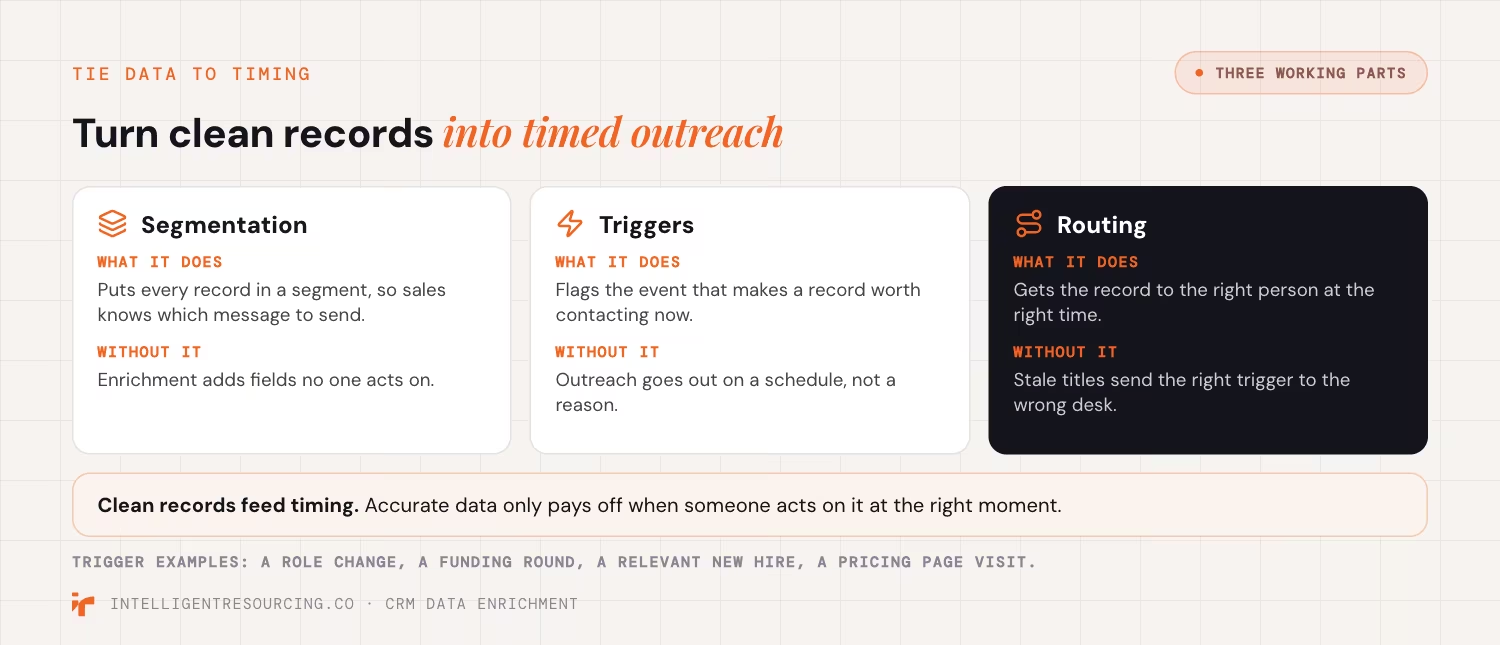
The 3 elements that connect enriched data to timely outreach:
- Segmentation: Every enriched record belongs to a segment: by industry, size, location or stage. The segment tells sales which message to send. Without it, enrichment adds fields no one acts on.
- Triggers: A trigger is the event that makes a record worth contacting: a role change, a funding round, a new hire in a relevant function, a pricing page visit. Clean, current records let triggers fire accurately.
- Routing: The record needs to reach the right person in the team at the right time. Stale job titles and wrong contact data cause routing failures even when the trigger is correct.
For a team without a RevOps owner, CRM enrichment work keeps records accurate and tied to segmentation. Clean records feed timing, and signal-led lead generation connects them to outreach.
Lead Generation
See how CRM enrichment keeps records accurate inside your own CRM and tied to the segments and triggers sales acts on.
FAQs
Is CRM data enrichment the same as data hygiene?
No. Data hygiene refers to the broader practice of keeping records clean, accurate and complete. Enrichment is one part of that: it adds missing attributes from external sources. Deduplication, validation and standardisation are other parts of data hygiene that do not require an external enrichment tool.
How do I choose the right data enrichment provider?
Run the same 200 records from your CRM through 2 providers and compare verified match rate, field accuracy and cost per usable record. Do this before committing to a contract. Match rate and accuracy on your specific data type matters more than a vendor's claimed overall coverage.
What is ABN matching and why does it matter?
ABN matching links a company record in your CRM to its Australian Business Number in the federal register. The match confirms the company's registered name, entity type and state. A matched record is more reliable for segmentation, reporting and compliance. The ABR publishes the ABN Bulk Extract weekly as a free download on data.gov.au. Access to the ABN Lookup web services needs registration and an authentication GUID.
How do I prevent enrichment from overwriting good data?
Set write rules that append to empty fields only, or that require the incoming value to be from a specified source and dated more recently than the existing value. Most CRM-native enrichment tools and major providers support conditional write rules. Configure and test these before running enrichment across your full record set.
What refresh frequency is right for Australian B2B teams?
There is no verified industry standard. Match the interval to how you use the record: active pipeline accounts monthly, ICP accounts not yet in pipeline quarterly, historical accounts every 6 months or on trigger only. ABN status and registered company details can be checked on trigger, because ASIC refreshes its public company dataset on data.gov.au every week.
Does CRM data enrichment need consent?
It depends. Enrichment is not the same as direct marketing. The Privacy Act, through Australian Privacy Principle (APP) 7, and the Spam Act can apply when you use personal information to market to individuals. Whether consent is required depends on your organisation, the data type and the message. Seek advice before using enriched contact data for outreach.