

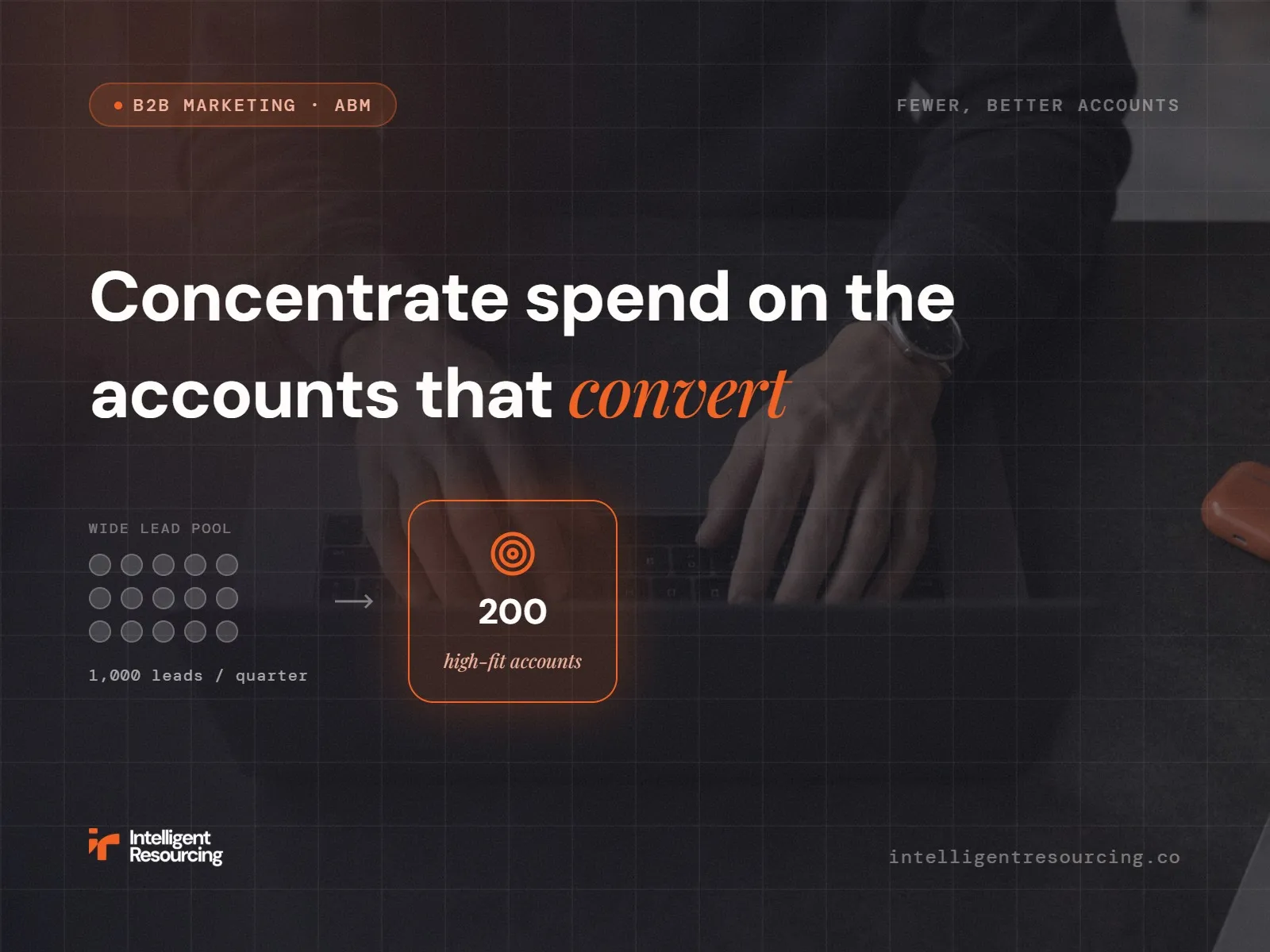
The main benefit of account-based marketing is better use of sales and marketing capacity. Instead of spreading budget across low-fit leads, ABM focuses attention on the accounts most likely to buy.
For Intelligent Resourcing, ABM is a concentration strategy: select fewer, better-fit accounts, align sales and marketing around them, and invest where the revenue potential is strongest. Most B2B teams already generate more leads than sales can act on, and many of those leads are a poor fit from the outset. The real challenge is rarely a lack of pipeline. It is a lack of pipeline worth working.
This article explains how ABM can improve pipeline efficiency, deal value, sales and marketing alignment, and customer retention.
What ABM Means for B2B
Account-based marketing focuses sales and marketing on a defined group of high-fit accounts rather than the wider market. The account, not the individual lead, becomes the unit of work, with messaging shaped around its wider buying committee.
“Fewer, better accounts” means removing poor-fit organisations so the strongest opportunities receive more attention. For Intelligent Resourcing, effective account-based GTM starts with selecting the right accounts, then aligning buying signals, messaging and execution around them.
Why B2B Is Shifting From Lead Volume to Account Value
Volume lead generation spends budget on low-fit MQLs that rarely convert, which inflates cost per opportunity and starves the accounts that actually move revenue. Fewer, better accounts means pointing that same spend at companies with genuine fit and intent.
The Problem With Lead-Based Marketing at Low Win Rates
Traditional B2B lead generation optimises for the top of the funnel: more forms, more MQLs, more raw volume. The catch is that most of that volume is noise. When the majority of leads never match the ideal customer profile, sales works a list that is mostly friction, and the cost of every real opportunity climbs because it is subsidising all the ones that went nowhere.
What "Fewer, Better Accounts" Fixes
Concentrating the same budget on high-fit accounts changes the maths. B2B companies with ABM programs report a 38% higher win rate, 91% larger deal sizes and 24% faster revenue growth than their non-ABM peers, on Salesforce's 2024 figures. Which means the shift is not about spending more; it is about pointing existing spend at accounts where a win is both more likely and worth more.
ABM vs Lead-Based Marketing: The ROI Comparison
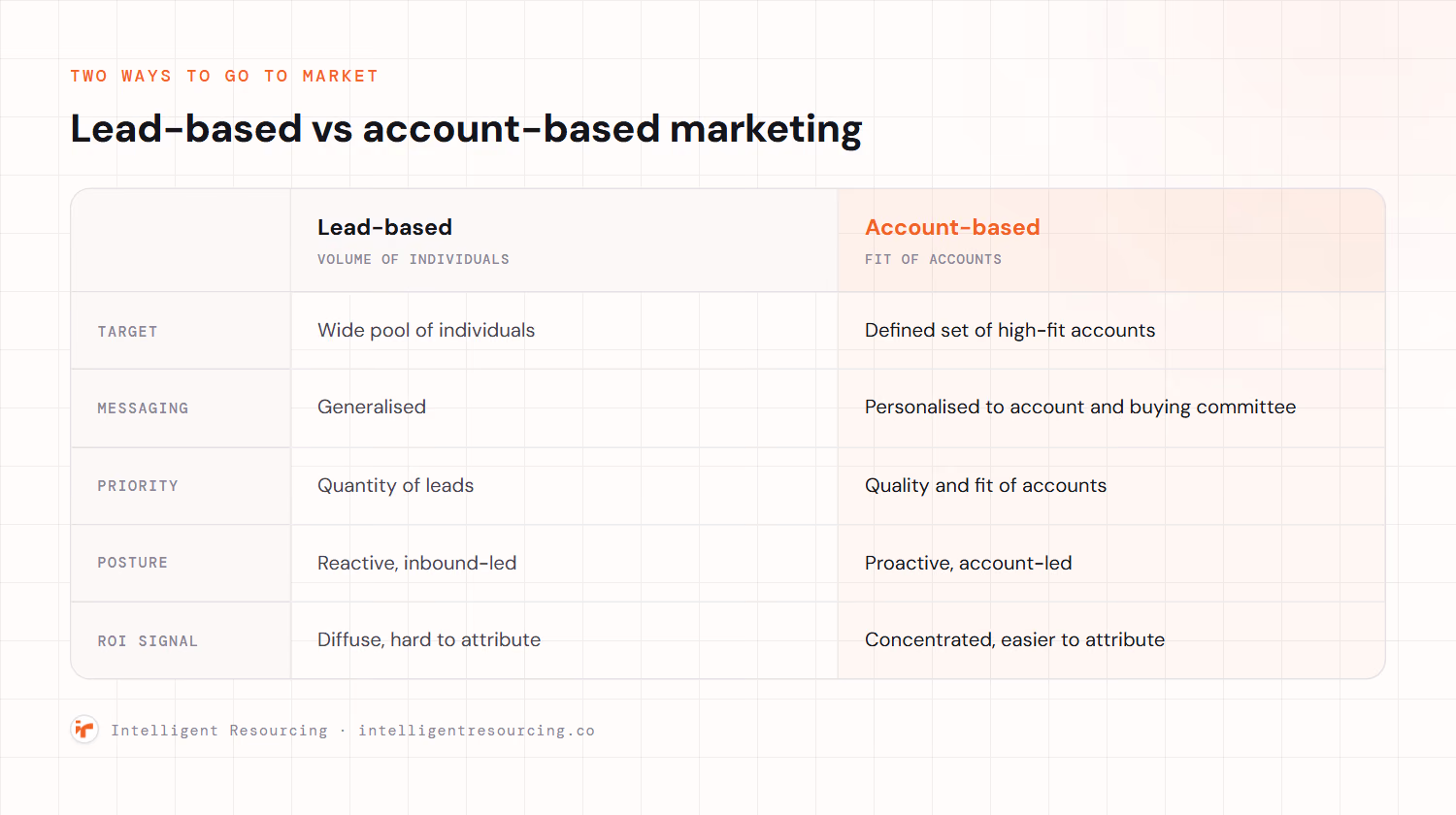
ABM and lead-based marketing are different bets on where return comes from: lead-based marketing bets on volume, ABM bets on fit. For considered, high-value B2B purchases, the fit bet tends to pay better.
Targets, Personalisation and Quality Versus Quantity
The two approaches diverge on almost every practical decision, from who you target to how you measure success.
| Dimension | Lead-based marketing | Account-based marketing |
|---|---|---|
| Target | Wide pool of individuals | Defined set of high-fit accounts |
| Messaging | Generalised | Personalised to account and buying committee |
| Priority | Quantity of leads | Quality and fit of accounts |
| Posture | Reactive, inbound-led | Proactive, account-led |
| ROI signal | Diffuse, hard to attribute | Concentrated, easier to attribute |
Where ABM Outperforms on ROI
The ROI evidence is consistent across the main benchmarks. Momentum ITSMA's 2023 benchmark found 77% of account-based programs report revenue growth, alongside 84% pipeline growth, and Salesforce's research finds a 38% higher win rate for adopters. Because ABM concentrates spend on a countable set of accounts, the return is easier to attribute, which means it is not only higher on average but more defensible to a CFO.
The Core Benefits of ABM for B2B
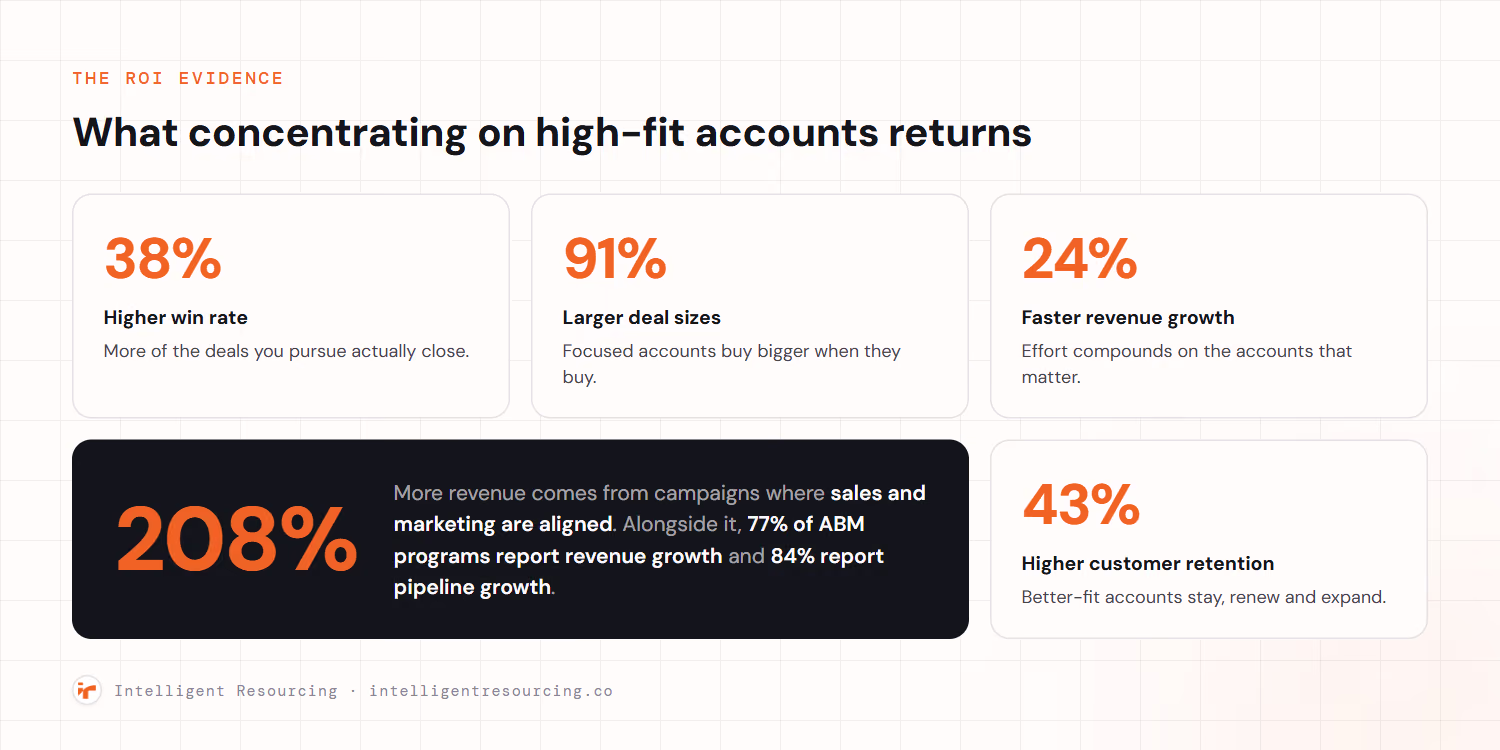
The core benefits of ABM are not vague promises; each ties to a measured outcome. The B2B ABM ROI statistics below map the benefit to the evidence.
| Benefit | Measured outcome | Source |
|---|---|---|
| Higher ROI and pipeline efficiency | 38% higher win rate, 91% larger deal sizes | Salesforce, 2024 |
| Larger deals and faster revenue growth | 24% faster revenue growth; 77% of programs report revenue growth, 84% report pipeline growth | Salesforce, 2024; Momentum ITSMA, 2023 |
| Stronger retention and expansion | 43% higher customer retention | Forrester, 2024 |
Higher ROI and Pipeline Efficiency
Concentrating spend cuts waste, and less waste shows up directly in pipeline metrics. Salesforce's 2024 figures show ABM adopters posting a 38% higher win rate and 91% larger deal sizes than non-ABM peers. Which means the same team, working a tighter list, converts more of what it touches and carries fewer dead opportunities through the funnel.
Larger Deals and Faster Revenue Growth
Personalising a high-value account's buying committee produces bigger deals and quicker revenue, because the message meets a real need rather than a generic persona. Salesforce reports 24% faster revenue growth for ABM adopters, and Momentum ITSMA's 2023 global benchmark found 77% of account-based programs report revenue growth, alongside 84% pipeline growth. That growth compounds with the larger deals noted above, so account focus lifts both the size and the speed of a typical win.
Stronger Retention and Expansion
ABM is not only an acquisition play; it applies to the accounts you already have. Customer-obsessed companies report a 43% increase in customer retention, on Forrester's 2024 research, and the account-level attention that wins a logo also drives renewals and cross-sell. So a mature program keeps paying after the first deal, through expansion revenue that costs far less than net-new acquisition.
How ABM Improves Sales and Marketing Alignment
ABM forces marketing and sales onto one shared account list, one ideal customer profile and one set of metrics, which removes the hand-off friction that wastes content and stalls deals. Alignment stops being a workshop goal and becomes a structural feature of how the two teams operate.
One ICP, One Target List, One Scorecard
Alignment comes from shared artefacts, not good intentions: a single agreed ICP, one unified target-account list, metrics both teams own, and a feedback loop where sales tells marketing which accounts are progressing. Aligned sales and marketing teams generate 208% more revenue from their campaigns than misaligned ones, and that gap matters because it shows alignment is a revenue lever, not a soft cultural goal. Disciplined lead scoring against the ICP keeps the list honest, so effort follows fit.
What Alignment Does to Sales-Cycle Length
Fewer, better-qualified accounts and cleaner hand-offs shorten the sales cycle, because sales spends less time re-qualifying what marketing sent and more time progressing real opportunities. When both teams work one list with one definition of a good account, the back-and-forth that usually pads a cycle largely disappears. Which means alignment is not a soft benefit; it shows up as deals that close in fewer touches and less elapsed time.
The Case for Targeting High-Value Accounts: What the Data Shows
Point the same budget at fewer, higher-fit accounts and the effective return per dollar rises, because both the win rate and the average deal size go up while the cost base stays flat. That is the thesis of ABM in one line.
The Efficiency Maths of Concentrating Spend
Take an illustrative 10-rep team working 1,000 leads a quarter at a 5% win rate, which is 50 wins. Redirect the same effort onto 200 high-fit accounts and apply the reported win-rate uplift, and the close rate on that tighter list climbs while each win carries a larger deal. Even with far fewer accounts in play, recovered pipeline can match or beat the volume approach, because you stop spending on the 95% that were never going to buy. The figures are illustrative, but the direction holds across the benchmarks above.
Named Results and Outcome Patterns
Documented outcomes cluster around three patterns: higher win rates, larger and faster deals, and less wasted spend. A mid-market B2B software company running a 1:few program, for example, usually sees engagement lift on its target list well before revenue moves, an early signal that the concentration is working. Those patterns trace to named studies, from Salesforce's 2024 benchmark to Momentum ITSMA's 2023 global benchmark, rather than any single vendor's claim.
How to Tell if ABM Is Right for Your B2B Team
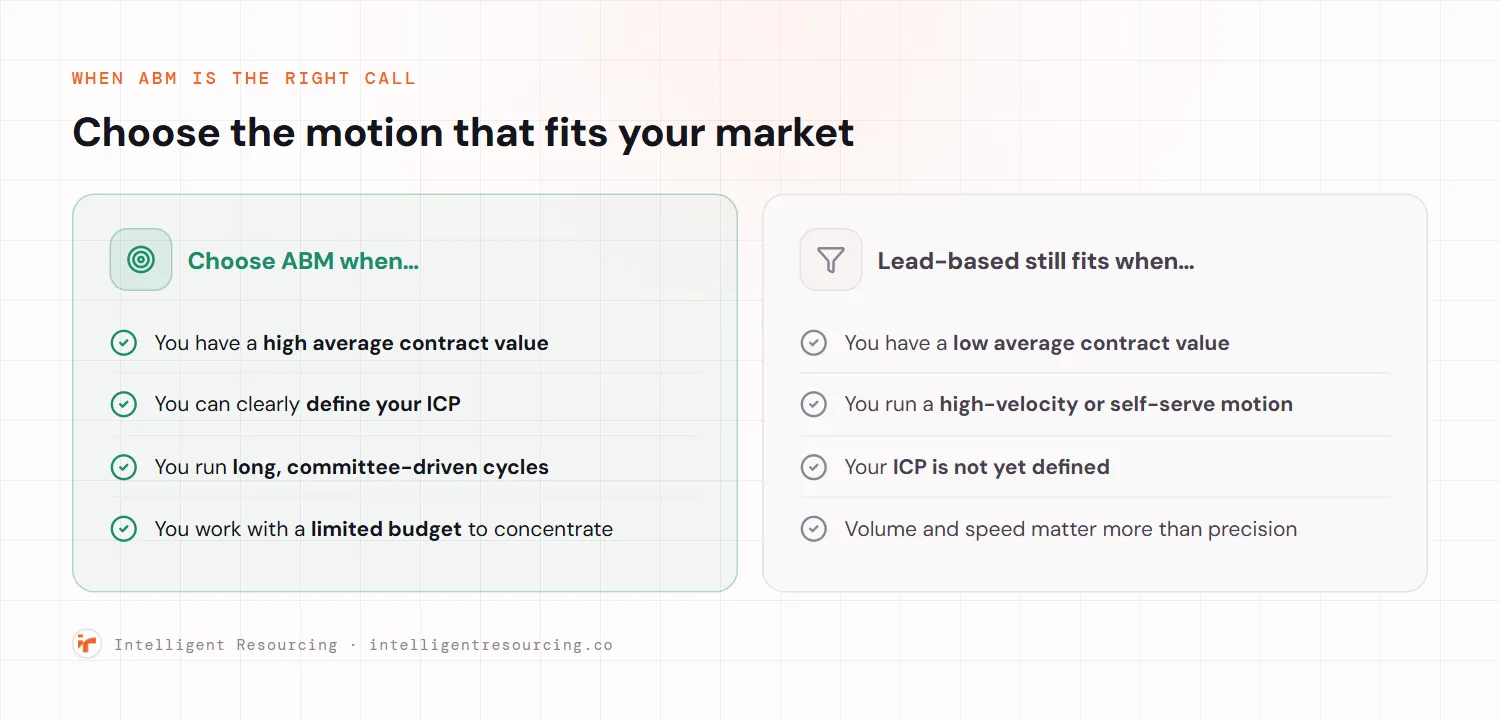
ABM earns its place when a few conditions line up: long sales cycles, high average contract value, a definable ICP, and a budget small enough that waste genuinely hurts. It complements rather than replaces lead generation, so treat it as a reallocation, not an all-or-nothing switch.
When Fewer, Better Accounts Is the Right Call
Choose ABM when a handful of logos would move your number, when buying committees are complex, and when cycles run long enough that per-account effort pays back. Use this short readiness check:
- High average contract value: each win is worth concentrating effort on.
- Definable ICP: you can name the accounts that fit.
- Long, committee-driven cycles: several stakeholders need tailored messaging.
- Limited budget: waste on low-fit leads is a cost you cannot absorb.
If most of these are true, fewer, better accounts is the stronger bet.
When Lead-Based Still Earns Its Place
Broad lead generation still makes sense when average contract value is low, when the motion is high-velocity or self-serve, or when the ICP is not yet defined. In those cases volume is a feature, not a bug, because the economics reward reach over depth. Salesforce frames ABM as a complement to demand generation rather than a wholesale replacement, so the honest answer for many teams is to run both and let account value decide the mix.
Lead Generation
We help B2B teams define the short list of accounts worth concentrating on and align sales and marketing behind it, so budget follows fit instead of volume.
FAQs
What Are the Main Benefits of Account-Based Marketing for B2B?
The main benefits are higher and more attributable ROI, larger deals, faster revenue growth, tighter sales and marketing alignment, and stronger retention, because spend is concentrated on high-fit accounts rather than spread across low-fit leads. Salesforce's 2024 benchmark puts the win-rate gain at 38% for B2B companies running ABM: fewer accounts, worked properly, convert at a higher rate and are worth more when they do.
Is ABM Better Than Lead-Based Marketing for B2B?
For considered, high-value B2B purchases, ABM tends to deliver higher and more attributable ROI, because personalisation and account focus lift win rates on deals worth the effort. Lead-based marketing suits low-ACV, high-volume or self-serve models, where reach and speed matter more than depth. Most mature teams run both and let account value decide the split.
What ROI Can a B2B Company Expect From ABM?
Reported returns are strong but conditional. Momentum ITSMA's 2023 benchmark found 77% of account-based programs report revenue growth, and Salesforce reports a 38% higher win rate for adopters. The word that matters is mature: results depend on account selection and execution, so a new program should expect a ramp, not the headline numbers, in quarter one.
How Does ABM Improve Sales and Marketing Alignment?
ABM gives both teams one shared ideal customer profile, one target-account list and one scorecard, so they stop arguing about lead quality and start working the same accounts. Aligned teams generate 208% more revenue from their campaigns than misaligned ones. The effect is less wasted content, cleaner hand-offs and shorter cycles, because both sides agree on what a good account looks like first.
How Many Accounts Should a B2B ABM Program Target?
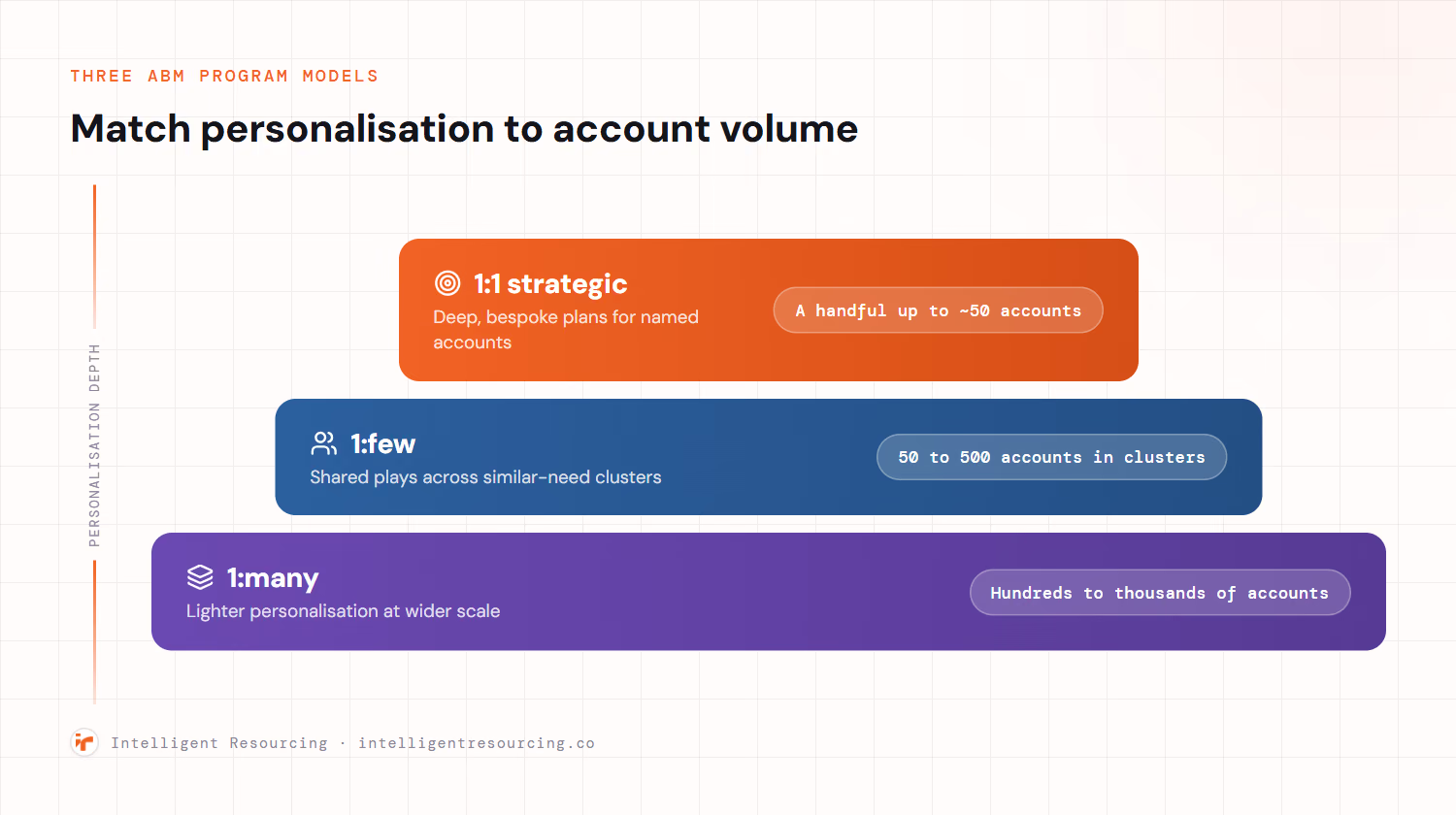
The right count follows the model. 1:1 strategic programs handle a handful up to about 50 accounts, 1:few covers 50 to 500 in clusters, and 1:many reaches hundreds or thousands with lighter personalisation. Start small with a pilot of clearly defined accounts, prove the motion, then scale, because a tight, well-run list beats a large one you cannot service properly.
Does ABM Work for Small B2B Teams?
Yes, with conditions. Small teams benefit most from focus, because they cannot afford to waste effort on low-fit leads in the first place. If you have a definable ICP and a contract value high enough to justify per-account work, a 1:few pilot of 20 to 50 accounts is a sensible start. Focus, not headcount, is what makes ABM pay for a small team.