

What Did the Content-Only Programme Achieve?

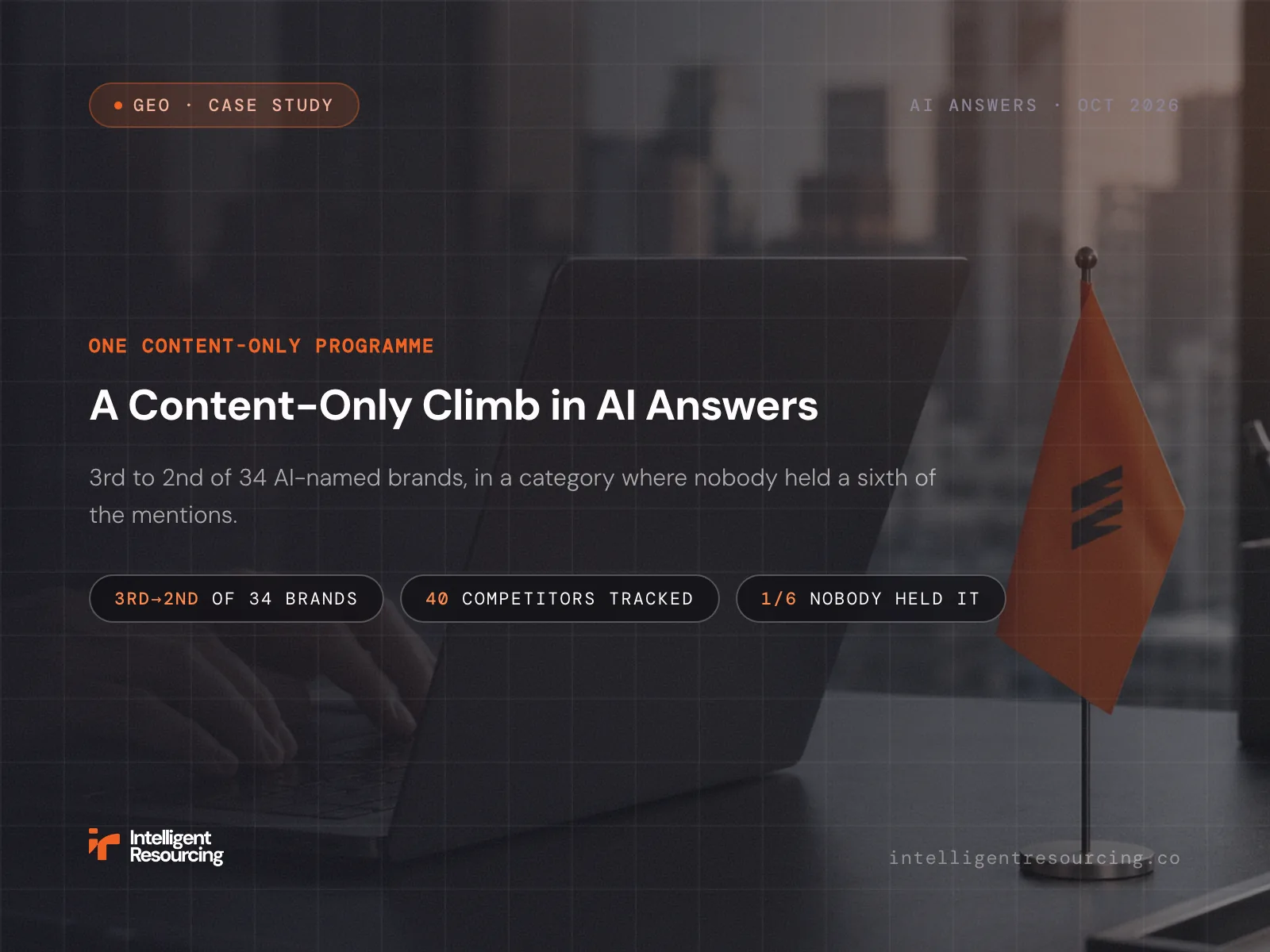
The programme moved an anonymised client from 3rd to 2nd of 34 brands that AI engines named in its category. The tracked set held 40 competitors. The reading was taken on 20 August 2026. The engine roster changed during the tracking window, so the move is reported with that change.
The roster change matters because engines rarely agree on sources. Kevin Indig's study of 3.7 million AI citations found that 91% of citations appeared on only 1 of ChatGPT, Perplexity and Google AI Overviews. Change the engines tracked, and the readings change with them.
| What was measured | Reading |
|---|---|
| Category position before | 3rd of 34 AI-named brands |
| Category position after | 2nd of 34 AI-named brands |
| Competitors in the tracked set | 40 |
| Reading date | 20 August 2026 |
| Programme type | Content only |
| Known confound | Engine roster changed mid-window |
This is a second Intelligent Resourcing GEO case example. The first, the Kynection share of voice case, followed a provider of unified software systems for transport, construction and mining to first place in its category. This case is narrower: 1 rank step, 1 programme type and 1 dated reading.
Why Was This Category Winnable With Content Alone?
The field was open because AI answers in it were fragmented. No brand held even 1/6 of the mentions across the tracked set. There was no dominant leader for engines to default to. In a fragmented field, clear and relevant content has more room to move a brand up.
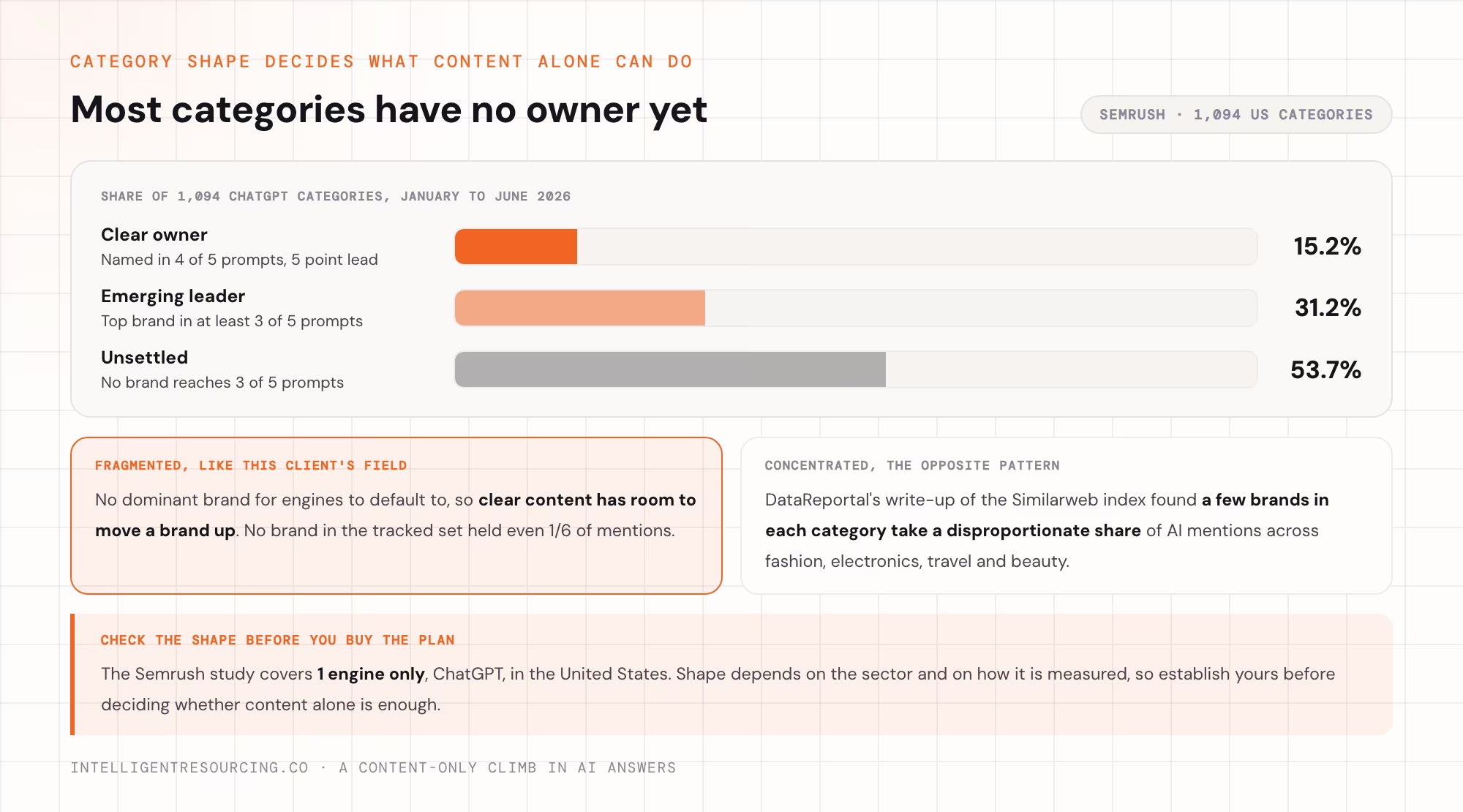
Other studies show how much the shape of a field can vary. The Semrush topic authority study, run with Kevin Indig, looked at 1,094 subject areas in ChatGPT in the United States.
Only 15.2% had a clear owner. Another 53.7% were unsettled, with no brand named in even 3 of 5 related prompts. The study covers 1 engine only.
Other data shows the opposite pattern. DataReportal's independent write-up of the Similarweb generative AI visibility index covers consumer sectors such as fashion, electronics, travel and beauty. It found that a few brands in each category take a disproportionate share of AI mentions. It also found some challenger brands accelerating, and visibility that can swing sharply from month to month.
So the shape of a field depends on the sector and on how it is measured. That is why the first question for any programme is what shape the field has. A page first has to be considered by an engine, then picked for the answer. In this client's field, the picking step stayed open, with engines choosing between many brands and no settled favourite.
What Did the Programme Change?
The programme changed only the client's owned content. The observed movement still reflects the wider AI-search environment, including the roster change. Content-only work improves how clearly pages answer buyer questions. It also makes those answers easier for engines to find.
AirOps, which sells AI-visibility tooling, publishes a guide to question keywords. It advises rewriting H2 and H3 headings as the questions buyers ask, or as direct answers, and adding FAQ sections to high-traffic pages. It also reports that 60% of question-word queries now produce an AI-generated summary, though it names no source for that figure.
A content-only programme for a software company usually works on 4 kinds of page:
- Buyer-question pages that answer 1 question each, with the answer in the first paragraph.
- Comparison pages that set the product against named alternatives on stated criteria.
- Use-case pages that tie the product to a specific job and buyer.
- FAQ sections on existing pages, written in the words buyers use.
Each page type answers a different buyer question, so they do not all help AI visibility equally. See which SaaS content types get cited for how that plays out when buyers compare, check and look for proof.
What Does This Result Prove, and What Does It Not?
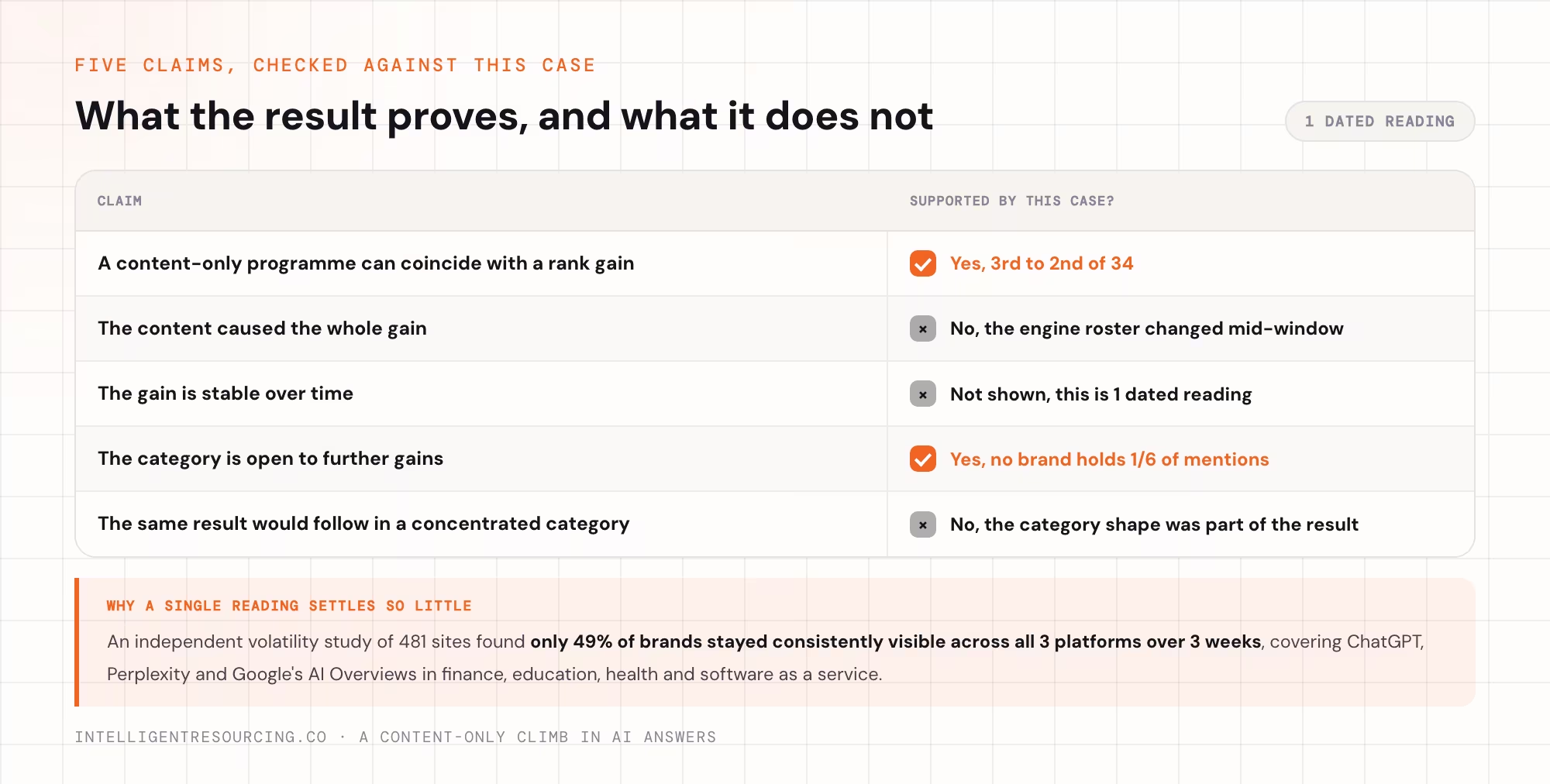
The result shows that a content-only programme can coincide with a brand climbing in a fragmented field. It does not prove the content caused the whole move, because the engine roster changed in the same window. It also comes from 1 dated reading, and AI visibility moves week to week.
Volatility is well documented. An independent volatility study of 481 sites, published on The Free Coalition, found that only 49% of brands stayed consistently visible across all 3 platforms over 3 weeks. It covered ChatGPT, Perplexity and Google's AI Overviews in 4 fields: finance, education, health and software as a service.
Software buyers ask about comparisons, product details, pricing and integrations. That mix changes what to measure and what to fix first. Our guide to GEO for B2B SaaS companies covers how to set those priorities.
What Should You Ask Before Buying a Content Programme?
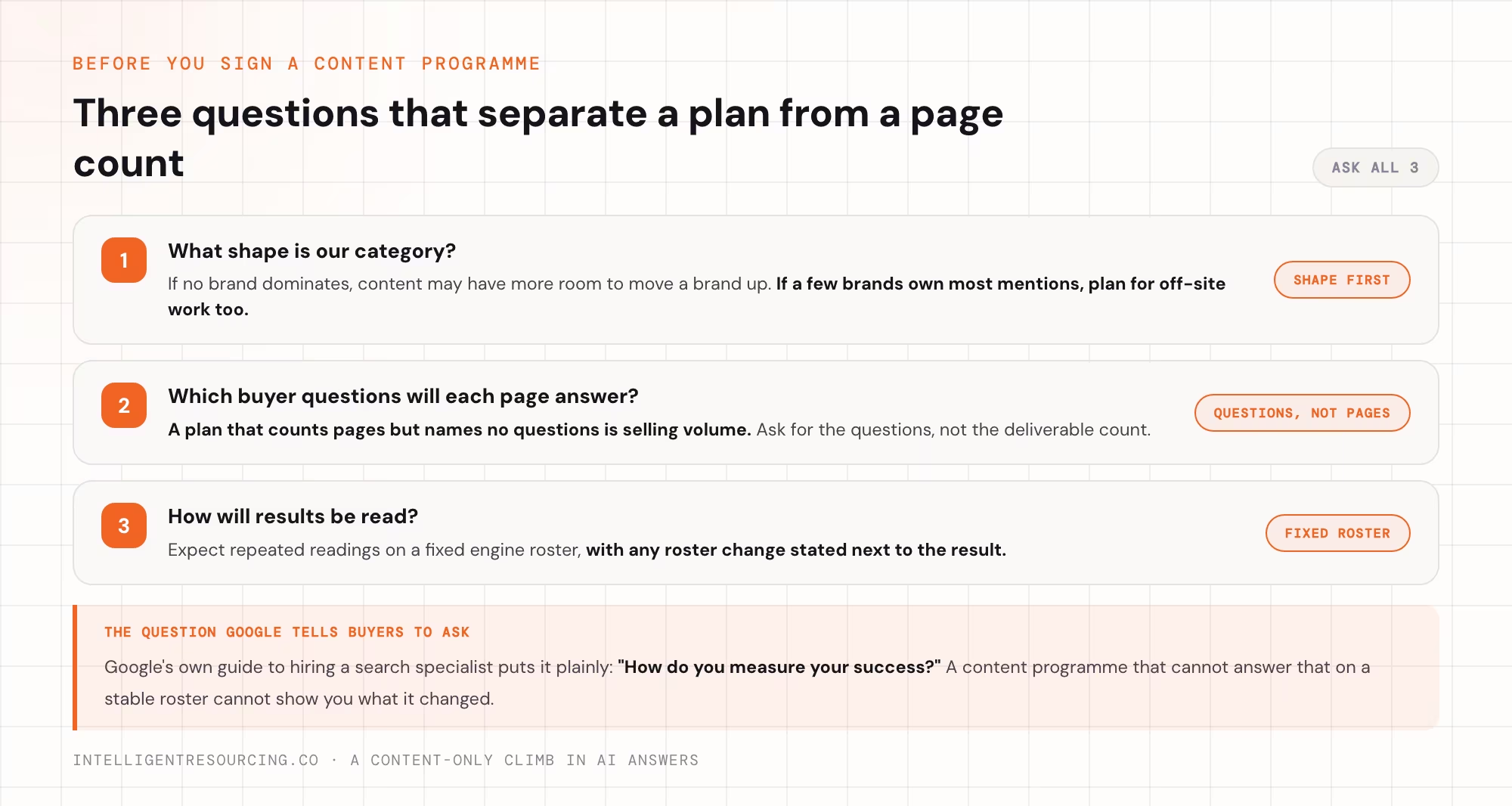
Google's own guide to hiring a search specialist tells buyers to ask how a provider measures success. For a content programme, ask 3 questions:
- What shape is our category? If no brand dominates, content may have more room to move a brand up. If a few brands own most mentions, plan for off-site work too.
- Which buyer questions will each page answer? A plan that counts pages but names no questions is selling volume.
- How will results be read? Expect repeated readings on a fixed engine roster, with any roster change stated next to the result.
A content programme is part of generative engine optimisation, which also covers technical access and measurement.
See Where Your Brand Sits in AI Answers
Find out which brands AI engines name in your category, how open the field is, and where content alone could move you up. Check your AI search visibility
Content Creation
FAQs
What did this GEO case study measure?
It measured the client's position among brands that AI engines named in its category. The client moved from 3rd to 2nd of 34 AI-named brands, within a tracked set of 40 competitors, on a reading dated 20 August 2026. It did not measure a raw citation count.
Did the content programme cause the rank gain?
Not on its own, as far as the data shows. The engine roster changed during the tracking window, so part of the move can reflect which engines were tracked. The case shows the programme and the gain happened together in a category open enough to allow movement.
Why does category shape matter for GEO results?
Concentrated categories give a few brands a larger share of visibility, while fragmented categories leave more competitive space open. In this case, no brand held even 1/6 of mentions, leaving room for relative position to change.
How is this case different from the Kynection case study?
The Kynection case followed a provider of unified software systems for transport, construction and mining to first place in its category, with a share-of-voice result. This case covers a different client, a content-only programme and a single rank step in a fragmented category, reported with the engine-roster caveat.
What should a report say when the tracked engines change?
It should state the change next to the result, with the date it happened. Compare readings only across the same set of engines, and start a new baseline when the set changes. Without that, part of any gain or loss may come from the switch, not the work.