
What Makes a GTM Workflow Worth Building First?
A GTM workflow is worth building first when buyers already show intent, it pays back within weeks, it runs without extra staff, and it helps more than one team. Score each workflow on those 4 factors from 1 to 5. The top total goes first, and anything under half marks waits.

| Factor | Question to ask | Score it 5 when |
|---|---|---|
| Signal strength | Are buyers showing intent? | A real event starts it, like a pricing page visit, a new sales head or a funding round |
| Speed to return | How fast does it pay back? | It adds pipeline within weeks, not quarters |
| Scale | Does it grow without more staff? | It runs from CRM triggers with no hand steps |
| Team impact | Who gains, and who blocks it? | Sales, marketing and customer success all use what it makes |
Signal strength carries the most weight, and timing is why. Gartner's March 2026 buyer survey of 646 business-to-business (B2B) buyers found 67% prefer a buying path with no sales rep. The same 2026 survey found 45% used AI during a recent purchase.
So buyers do most of their research alone, and a workflow that reacts to real buying signals reaches them while they still weigh their options.
Here is how one runs. The system spots a new head of sales at a target account and adds company data to the CRM record. Then it starts a short email sequence within 24 hours, and we call that moment a Verified Buying Window™.
How Do You Score GTM Workflows With RICE, ICE or Impact vs Effort?
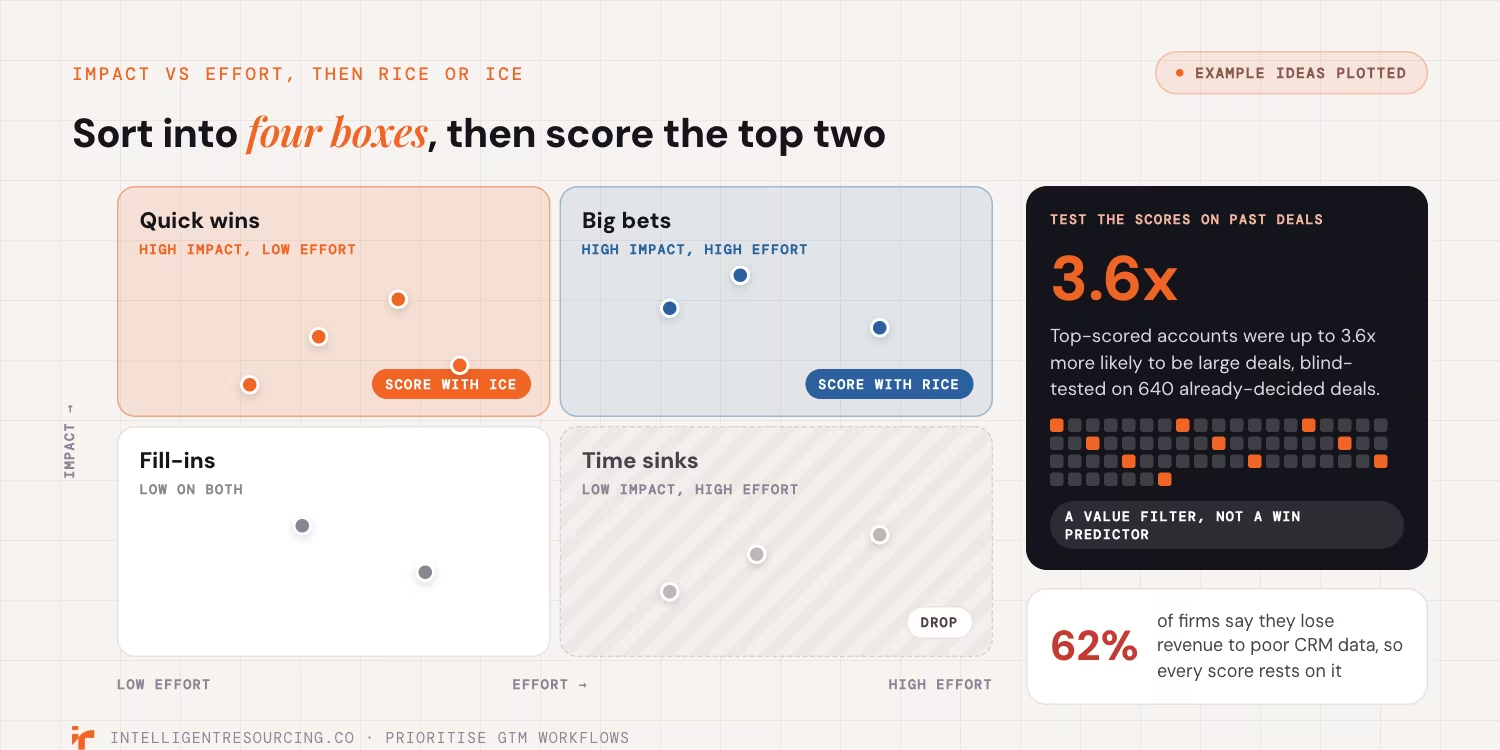
Use an impact vs effort matrix for a fast first sort. Then use RICE or ICE to rank what is left. RICE multiplies reach, impact and confidence, then divides by effort, while ICE drops reach and runs faster. Both break when the inputs are guesses, so tie each score to real CRM data.
Here is the order we use:
- List every idea. Put each workflow on 1 shared sheet, with an owner next to it.
- Sort into 4 boxes. Quick wins are high impact and low effort. Big bets are high impact and high effort. Fill-ins are low on both. Time sinks are low impact and high effort.
- Score the top 2 boxes. Use RICE for big builds and ICE for small tests.
- Break ties with the 4 factors. Signal strength wins a tie.
- Test the scores on past deals. Check that the top scores match what really sold.
Confidence is the weakest input, because it rests on your data. A 2026 Validity CRM data survey of 500 marketers found 62% of firms say they lose revenue to poor CRM data. If the data is wrong, every score built on it is wrong too.
That is why the last step matters, and in our work a score has to earn trust before it ranks anything. Blind-tested on 640 of a client's already-decided deals, our scoring did not predict who would win, but the top-scored accounts were up to 3.6x more likely to be large deals. A value filter, not a win predictor.
The same test works for lead scoring models you already run.
Which GTM Workflows Should You Automate First?
Automate the repeat tasks that eat rep time and feed every other workflow. That means data entry, record checks, lead routing and follow-up alerts. These score high on speed and scale, because they save hours each week and need no new staff. Leave the pitch, the call and the deal plan to people.
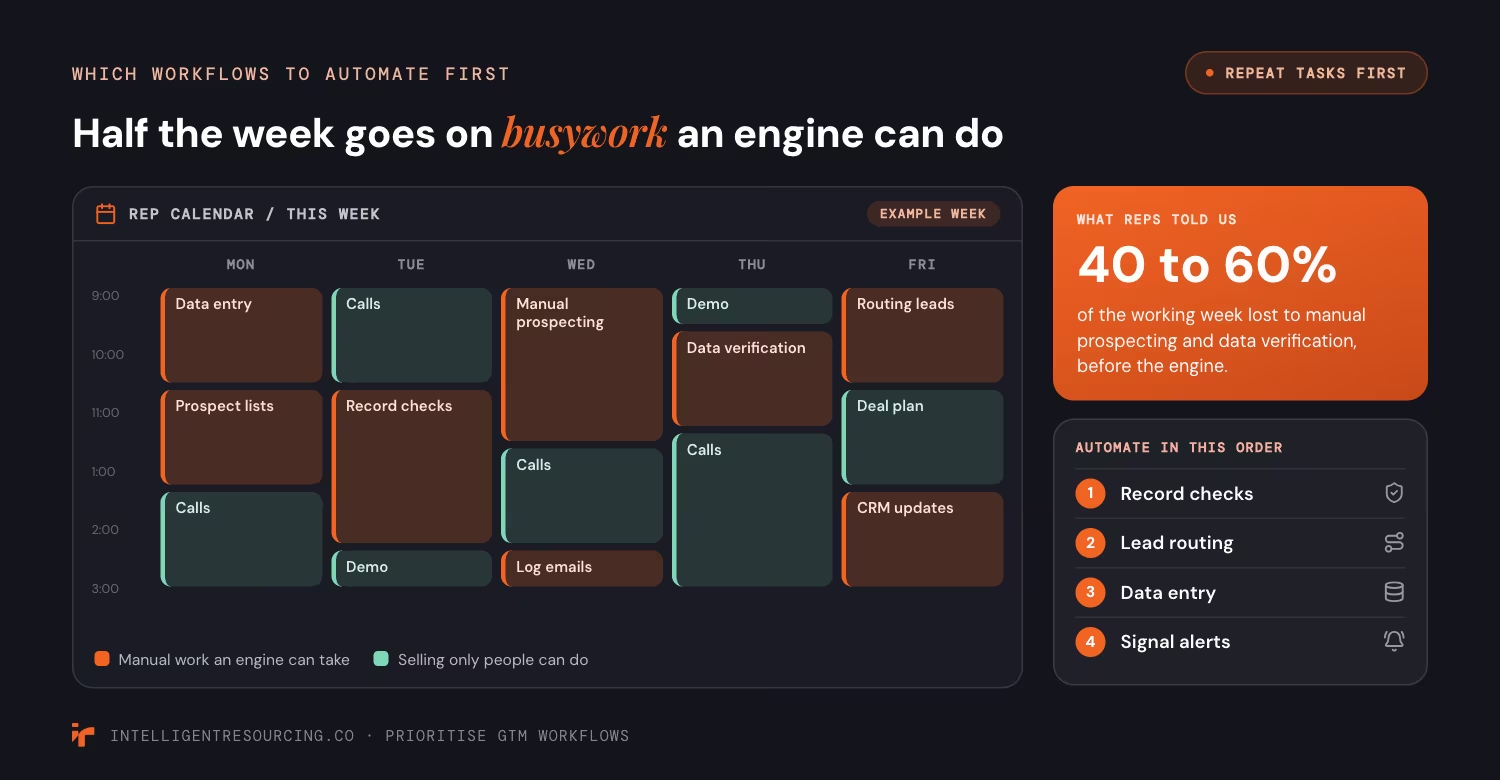
The time cost is large. Salesforce's seventh State of Sales report, from a 2025 survey of 4,050 sales staff, found reps spend more than half their time on non-selling work like data entry and prospecting. We see the same in our work. Across multiple B2B clients, business development reps reported losing 40 to 60% of their working week to manual prospecting and data verification before the engine.
Start with these 4, in this order:
- Record checks. Fill missing company and contact fields on every new record, and flag what you cannot confirm.
- Lead routing. Send each new lead to the right rep within minutes, not days.
- Data entry. Log calls, emails and meetings to the CRM without a rep typing them in.
- Signal alerts. Tell the account owner when a target firm hires, raises money or changes tools.
Record checks come first, because every other workflow reads those records. When we cleaned up one client's CRM, we took 4,665 uncategorised CRM leads, categorised and enriched every one, and narrowed them to the core ideal customer profile (ICP), work that would take a sales team hundreds of hours by hand. For the full list, work through our RevOps automation checklist.
Should You Automate, Hire or Bring In a Specialist?
Automate first when your top workflows are repeat tasks with few judgement calls. Hire when the work needs a person every day, like live sales calls. Bring in a GTM engineering specialist when you need the build done in weeks and nobody on the team knows the tools. Each step costs more than the last, so go in that order.

A new hire is slow to pay back. The Bridge Group's 2025 study of 351 B2B companies found the average sales development rep (SDR) takes 3.0 months to ramp. The same 2025 study found only 60% of SDRs hit quota, the lowest in its history.
| Option | Pick it when | Watch for |
|---|---|---|
| Automate | The task repeats daily and follows clear rules | Bad data makes bad automation faster |
| Hire | Deals are large, complex and need trust built over calls | Months of cost before the first meeting |
| Specialist | You need the system built fast and handed over | Pick one who hands you the keys, not a lock-in |
Hiring still wins in one case. When each deal is large and the buyer wants a person they trust, a skilled rep beats any system. For everything else, a GTM engineering partner builds the system once, and you own it from day one.
How Do You Get Sales and Marketing to Agree on GTM Priorities?
Get sales and marketing to agree by scoring the list together, with 1 shared sheet and 1 shared goal, such as qualified pipeline. Give each workflow 1 owner. Then re-rank the list every quarter, or sooner after a big shift in goals, team or data.
Most teams start far apart. A Gartner survey from June 2024 of 412 marketing and sales leaders found 90% say their team priorities clash. The 2024 survey also found the 2 teams work together on only 3 of 15 shared tasks.
Run a 1-hour priority meeting each quarter:
- Bring the data. Each team brings hours lost, leads stuck and deals lost, by workflow.
- Score out loud. Both teams score each workflow on the 4 factors, in the room.
- Name 1 owner. Each workflow gets 1 person who is on the hook for it.
- Set 3 numbers. Track hours saved per week, meetings booked and pipeline created.
- Cut what misses. Drop any workflow that misses its numbers 2 quarters in a row.
A shared score ends the turf fight, because both teams can see why a workflow won. If you want a second view on your list, book a workflow review with our team.
GTM Engineering
Our GTM engineering team scores your workflow list with you and builds the top one, so you own it.
FAQs
What is the best prioritisation framework?
There is no single best one, but for GTM work a signal scorecard works best, because it scores buyer intent and timing. RICE suits big builds that touch many accounts. An impact vs effort matrix suits a fast first sort.
How do you calculate a RICE score?
Multiply reach by impact by confidence, then divide by effort. Reach is how many accounts the workflow touches in a set time. Confidence is how sure you are, as a percentage. Effort is the person-weeks it takes to build.
What are the four quadrants of an impact effort matrix?
Quick wins are high impact and low effort, so do them first. Big bets are high impact and high effort, so plan them. Fill-ins are low on both, and time sinks are low impact and high effort, so drop the time sinks.
What are common mistakes when setting GTM priorities?
Watch for 3 mistakes: ranking on gut feel in a large market, trusting scores built on bad CRM data, and hiring before you automate. Another is never re-ranking. Then old priorities keep eating the budget.
How often should you review GTM priorities?
Review them every quarter. Review sooner after a funding round, a new sales head or a change in target market. Each review should re-score the whole list, not just add to it.
What is a GTM engineer?
A GTM engineer builds the systems that run sales and marketing work. They connect the CRM, data sources and outreach tools, then automate the steps between them. The role sits between sales operations and software engineering.