

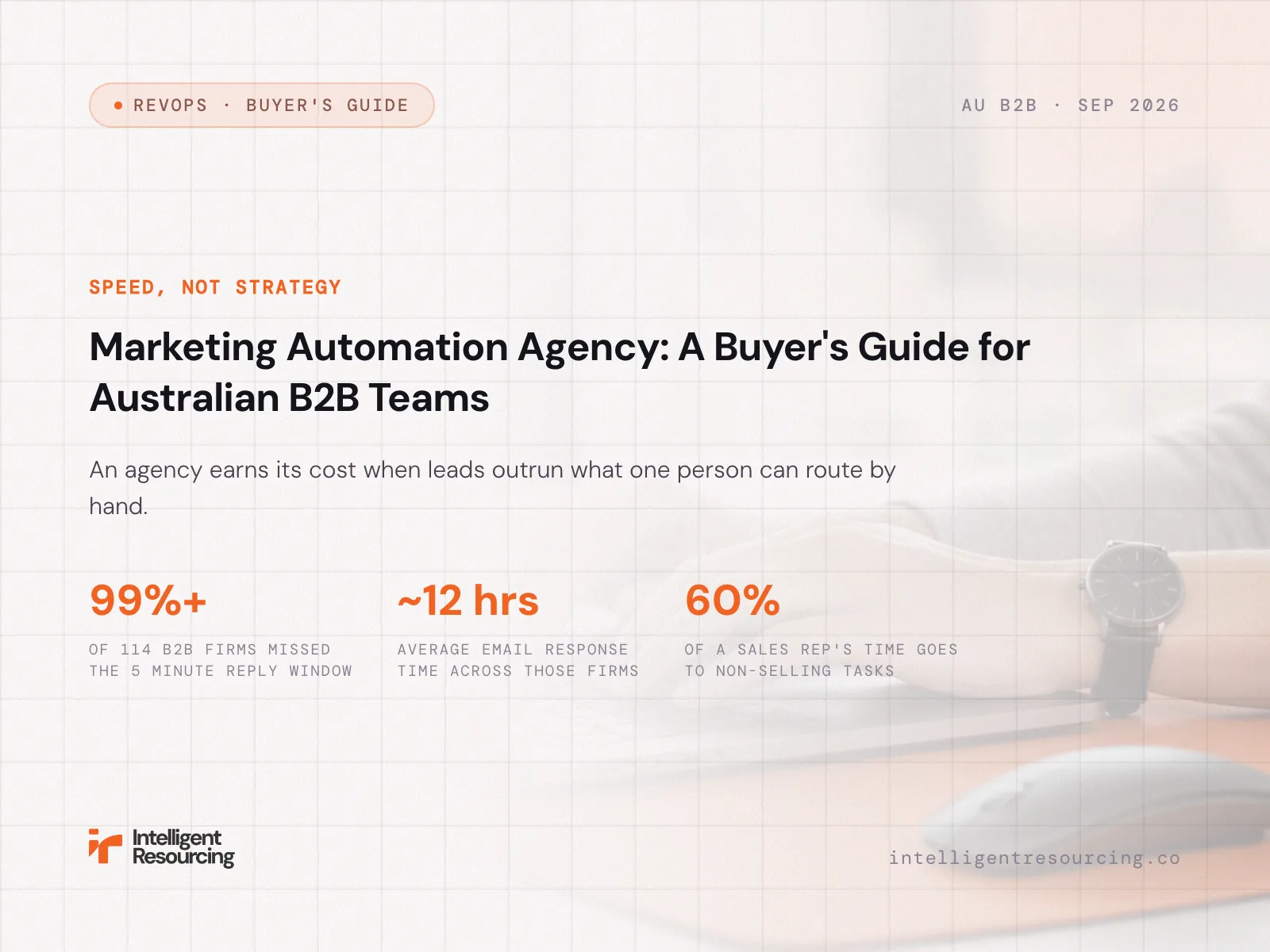
What Does a B2B Marketing Automation Agency Actually Do?
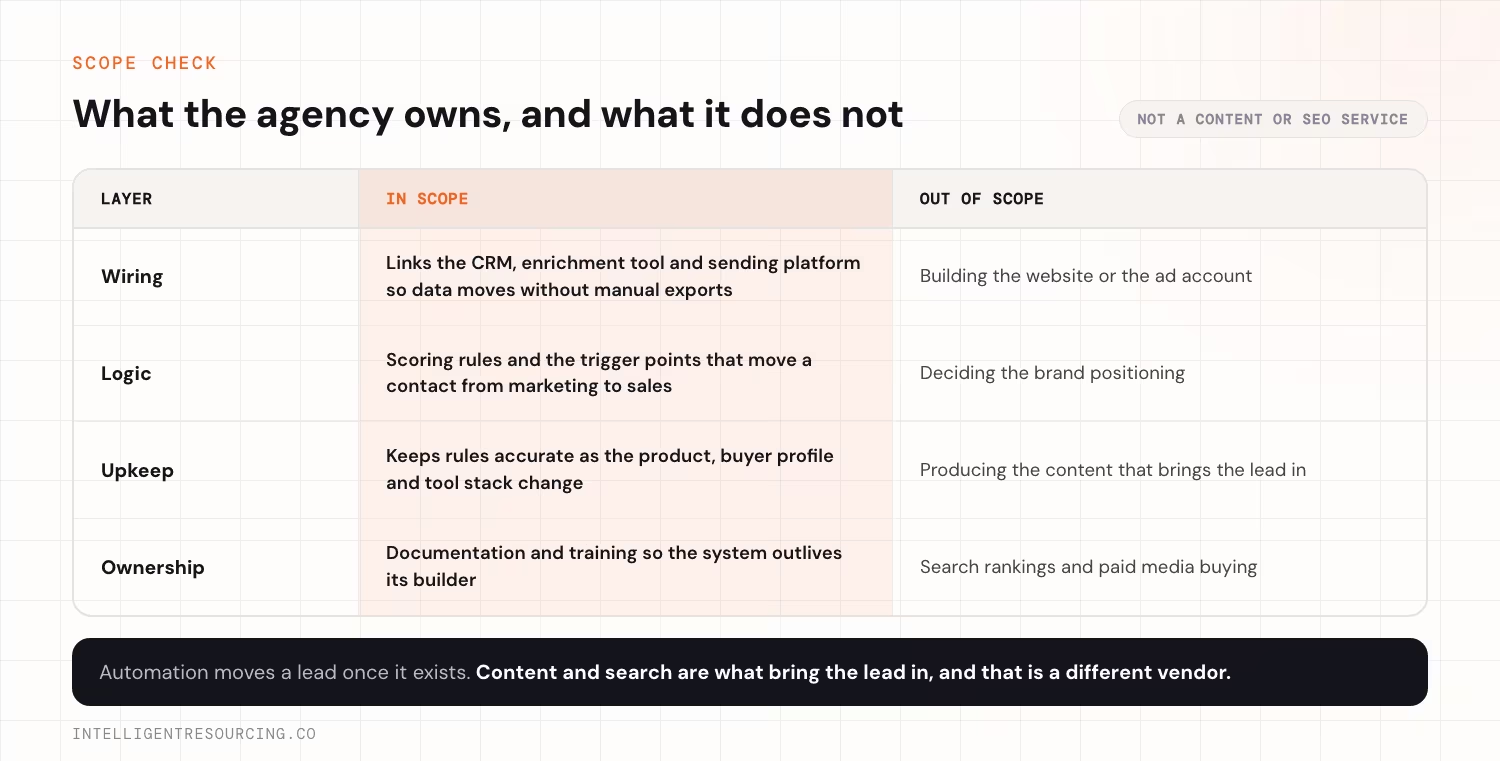
A B2B marketing automation agency designs and runs workflows. These turn a raw lead into a scored, routed, sales-ready contact. The work covers CRM setup, lead scoring, nurture sequences and linking tools like HubSpot, Salesforce and Clay. It sits inside GTM engineering, not content or advertising.
The job splits into three parts. Wiring links the CRM, the enrichment tool and the sending platform. Data then moves between them without manual exports. Logic sets the scoring rules and trigger points that decide when a contact moves from marketing to sales. Upkeep keeps those rules accurate as the product, the ideal customer profile or the tool stack changes.
Content Marketing Institute research, reported by eMarketer in 2026, found that 45% of B2B marketers worldwide are prioritising investment in artificial intelligence (AI) marketing tools for 2026. Automation has moved from optional to essential in most go-to-market stacks. That is why the workflow layer needs a specialist, not a generalist bolt-on. If the category itself is still new to your team, start with what B2B marketing automation actually is.
What Signs Show You Need a Marketing Automation Agency, Not More Software?
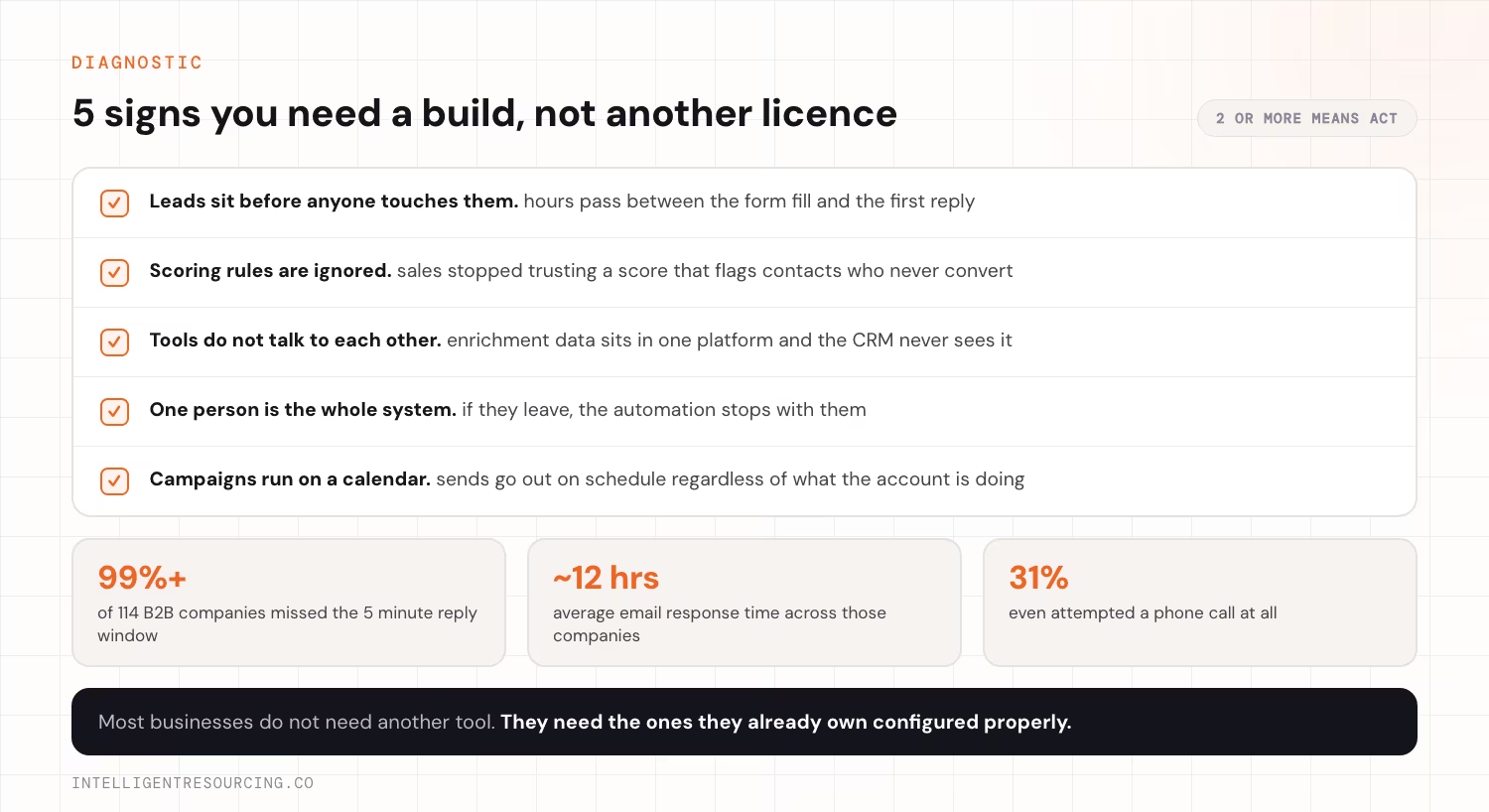
Most businesses do not need another tool. They need someone to configure the ones they already own properly. The clearest signs are leads sitting unrouted for hours, a lead score nobody trusts, and a CRM sales has stopped checking.
- Leads sit before anyone touches them. Workato's research across 114 B2B companies found more than 99% failed to respond to a new lead within 5 minutes, with average email response time close to 12 hours.
- Scoring rules are ignored. Sales stops trusting a lead score once it flags contacts that never convert.
- Tools do not talk to each other. Enrichment data sits in one platform and the CRM never sees it.
- One person is the whole system. If that person leaves, the automation stops with them.
- Campaigns run on a calendar, not on behaviour. Sends go out on schedule regardless of what the account is actually doing.
If more than 2 of these are true, 10 workflows built around real triggers show what the alternative looks like in practice.
How Do You Evaluate a Marketing Automation Agency in Australia?
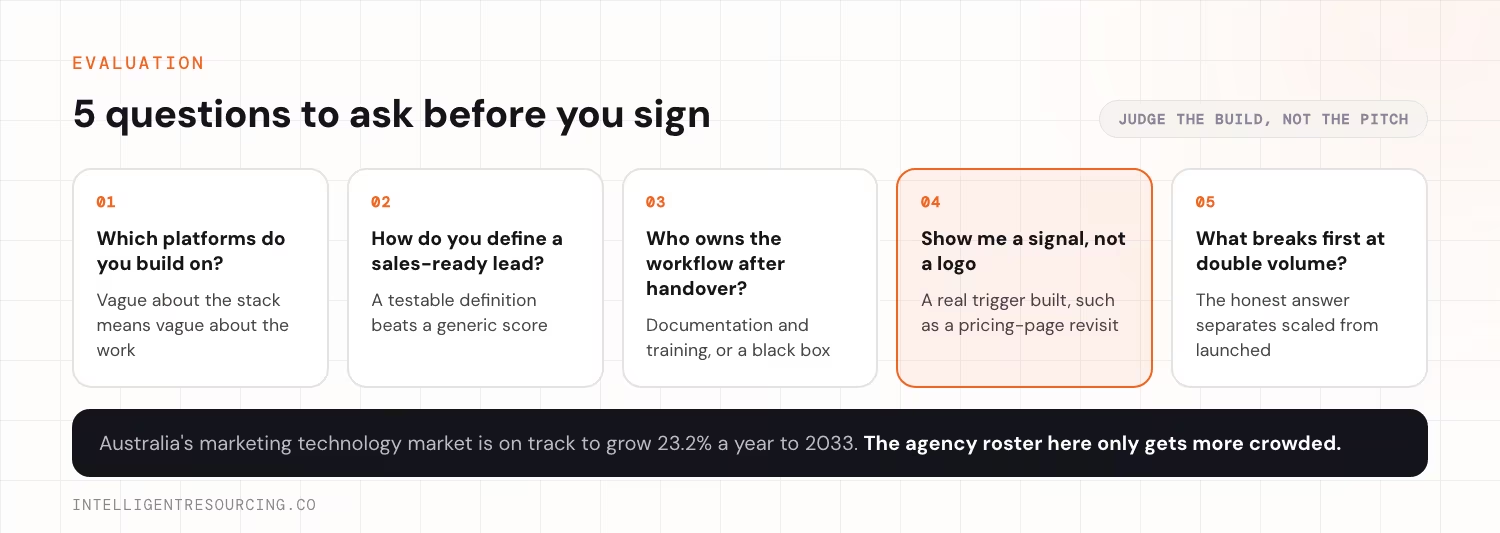
Evaluate a marketing automation agency on what it builds, not what it promises. Ask which platforms it works in, how it defines a sales-ready lead, and what happens to the workflow once the contract ends. Australia's marketing technology market is on track to grow 23.2% a year to 2033. The agency roster here is only going to get more crowded.
- Ask which platforms they actually build on. HubSpot, Salesforce and Clay each need different skills. An agency vague about its stack is vague about its work.
- Ask how they define a sales-ready lead. A specific, testable definition beats a generic lead score every time.
- Ask who owns the workflow after handover. Some agencies leave documentation and training. Others leave a system only they can touch.
- Ask for a signal example, not a case study logo. A concrete trigger they have built, such as a hiring signal or a pricing-page revisit, shows real capability.
- Ask what breaks first when volume doubles. The honest answer separates an agency that has scaled a system from one that has only launched one.
The results this kind of programme can produce are covered in more detail in these revenue-linked automation examples.
Why Do Most Marketing Automation Engagements Underperform?
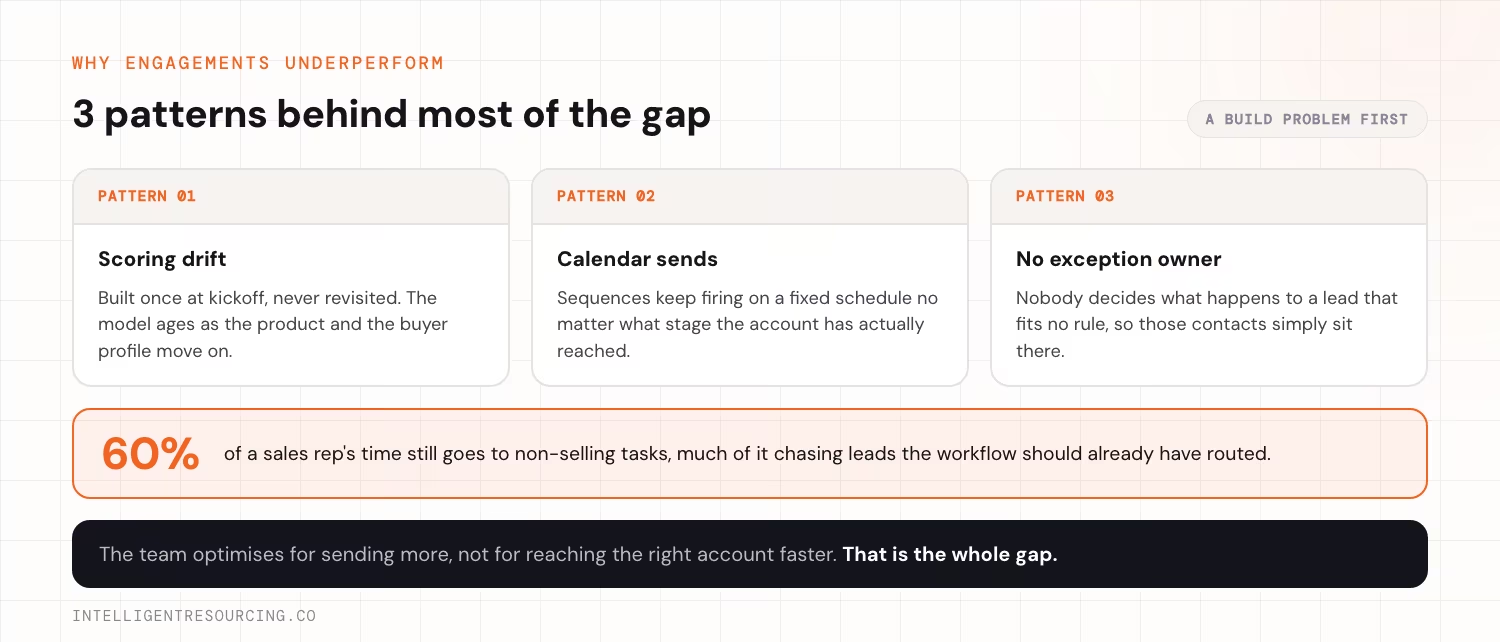
Most marketing automation engagements underperform for one reason. The team optimises for sending more, not for reaching the right account faster. Salesforce's 2026 State of Sales reporting found reps still spend 60% of their time on non-selling tasks, much of it chasing leads automation should already have sorted.
Three patterns explain most of that gap. Scoring models get built once at kickoff and never revisited. They drift as the product and the buyer profile change. Sequences keep firing on a fixed schedule no matter what stage the account has actually reached. And exception handling has no owner: nobody decides what happens when a lead does not fit any rule, so those contacts just sit there.
Fixing this is a build problem before it is a strategy problem. Engineering the handoff properly closes most of the gap on its own, without a bigger budget.
Every month spent on calendar-based sends is a month of signal-ready pipeline going to whoever routes it first.
Why Choose Intelligent Resourcing as Your Marketing Automation Agency?
Intelligent Resourcing builds marketing automation around Signal-Led Growth: workflows that trigger on real buying behaviour instead of a send calendar. Every build runs inside the Verified Buying Window: the period when a detected signal is still fresh. Sales gets a contact worth calling, not a stale one.
A typical build covers three things. Clay enrichment confirms who a contact is and what has changed at their company. HubSpot or Salesforce workflow logic scores and routes that contact. n8n connects the tools that do not talk to each other on their own. None of it depends on one person's memory of how the system was set up.
If You Are Scaling Past One Founder-Led Sales Motion
Once a founder or a single sales hire can no longer follow up on every lead by hand, a workflow has to take over. It needs to do, by rule, what that person used to do by instinct. That is a build project, not a hiring decision.
If Your CRM Has More Data Than Anyone Trusts
A CRM full of unscored, unrouted contacts is not a data problem. It is a missing set of rules for what to do with that data, which is exactly what a marketing automation agency is meant to define.
If You Have Already Decided to Bring In a Marketing Automation Agency
The next step is a working session on the current stack: what is connected, what is scored, and where the first signal-led workflow should go live.
RevOps Tools
See the first signal-led workflow mapped in a week: what is connected, what is scored, and where the first trigger should go live.
FAQs
What is the difference between a marketing automation agency and a content or SEO agency?
A marketing automation agency configures CRM workflows, lead scoring and sequencing. A content or SEO agency produces the pages and assets an audience finds. The two rarely overlap: automation moves a lead once it exists, content and SEO are what bring the lead in.
How much does a marketing automation agency cost in Australia?
Pricing is not standard across the market. Most agencies quote by scope rather than a flat rate. Expect a discovery-and-build phase priced apart from an ongoing management retainer, with that retainer scaling to the number of workflows you keep running.
How long does it take to see results from marketing automation?
A first signal-triggered workflow usually goes live within weeks of kickoff. That is because it wires existing tools together rather than building new ones. Measurable pipeline impact usually takes a full sales cycle to show. That is how long it takes leads to move all the way through.
Can a marketing automation agency work with our existing HubSpot or Salesforce setup?
Yes, in most cases. The work is usually resetting and connecting tools, not a rebuild: linking enrichment data, fixing scoring logic and adding routing rules to the CRM you already use.
When should a business handle marketing automation in-house instead of hiring an agency?
Below about 50 inbound leads a month, with one product line, one CRM and someone who knows the platform, in-house is the right call. An agency earns its cost once volume, tool count or product lines grow past what one person can manage.